

Risk Management · 2025
In this section2 topics
Risk Management Policy & Plan
Policy & Plan Description
G-Able Public Company Limited (the "Company") recognizes the importance of risk management in facilitating its business conduct to achieve its strategy, objectives, and goals, including good corporate governance and sustainable growth across economic, social and environmental dimensions. Managing risks allows the Company to identify potential opportunities and challenges and to prepare preventive plans to control and mitigate impacts, as well as to reduce unforeseen events that may occur in the future. This approach ensures that the Company's desired outcomes are achieved by using appropriate resources and adjusting business strategies, both proactively and responsively, and the impacts are relieved to be at an acceptable level. Therefore, the Company has established a risk management policy and manual by applying the international standard set by The Committee of Sponsoring Organizations of the Treadway Commission - Enterprise Risk Management (COSO - ERM) that outlines the risk management framework based on business operations-related processes through 5 components. These components include governance and culture, strategy and objective-setting, performance, risk identification, review and revision, and information, communication and reporting.
Risk Management Structure
(It was reviewed on 18 February 2025 by the Risk and Sustainability Development Committee.)
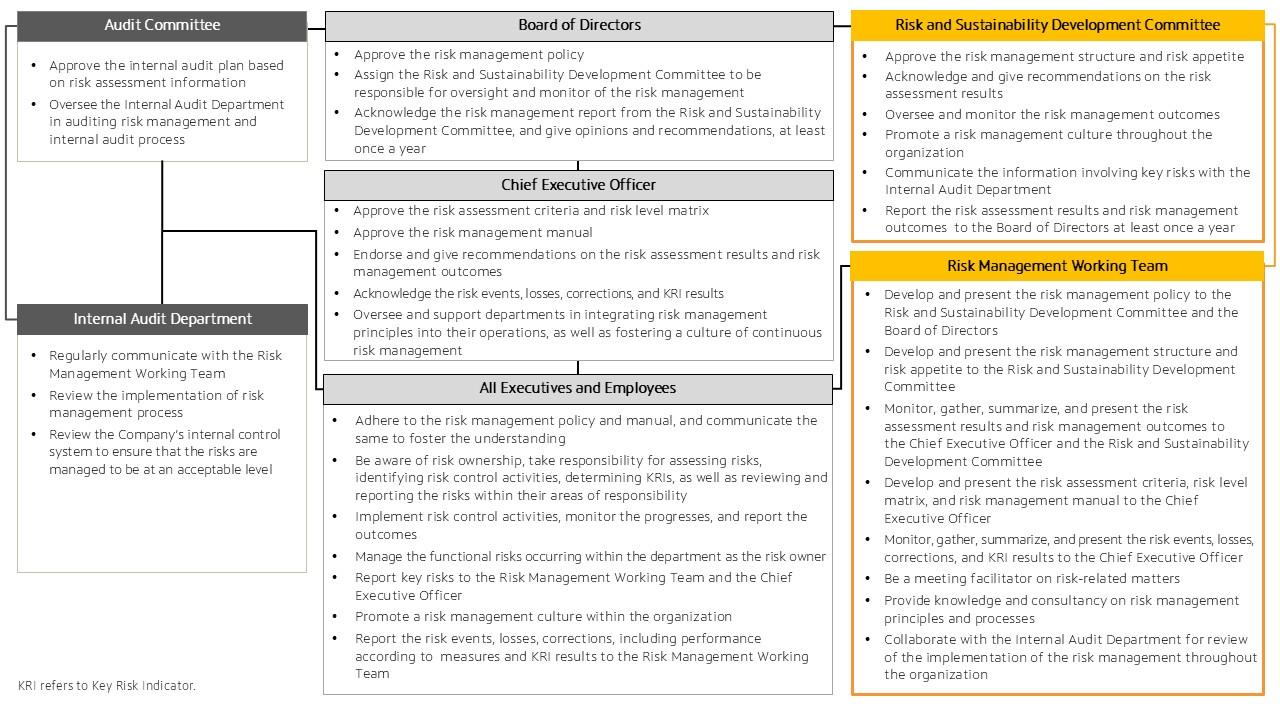
Risk Management Process
Risk management process of the Company covers the risk identification, risk assessment, risk mitigation plan to reduce risk level to an acceptable level, risk monitoring through KRIs results to ensure that the risks are managed in an appropriate manner, and regular risk reporting to the executives. In addition, the Company determines the level of risk appetite (comprising of the Corporate Risk Appetite Statement and qualitative risk measurement) and risk tolerance and applies a heat map with the criteria of likelihood and impact, both in terms of financial and non-financial, in risk assessment and prioritization. In this regard, the Company classifies its risks into 5 categories, including strategic risk, operational risk, financial risk, compliance risk, and emerging risk1. Additionally, the Company conducts fraud and corruption risk assessments, which are classified as operational risk.
1 Emerging risk refers to newly arising external risks that are unexpected or highly uncertain, significant in nature, and characterized by specific attributes. It may have long-term impacts, for 3 to 5 years, on the industry or the Company and its subsidiaries (collectively, the "Group")'s business.
Risk Management Culture
Promoting a risk management culture within an organization is a critical factor in the successful implementation of risk management. Consequently, risk management of the Group is conducted at both enterprise and functional levels, requiring all executives and employees to take ownership of the risks within their respective responsibilities both individually and in collaboration with other departments by specifying this in the Company's Risk Management Policy as a fundamental term. The roles and responsibilities of the Chief Executive Officer, as the top organizational management, in continuously promoting a risk management culture, are defined. Therefore, training and seminars are organized to raise awareness of risk management across the organization.
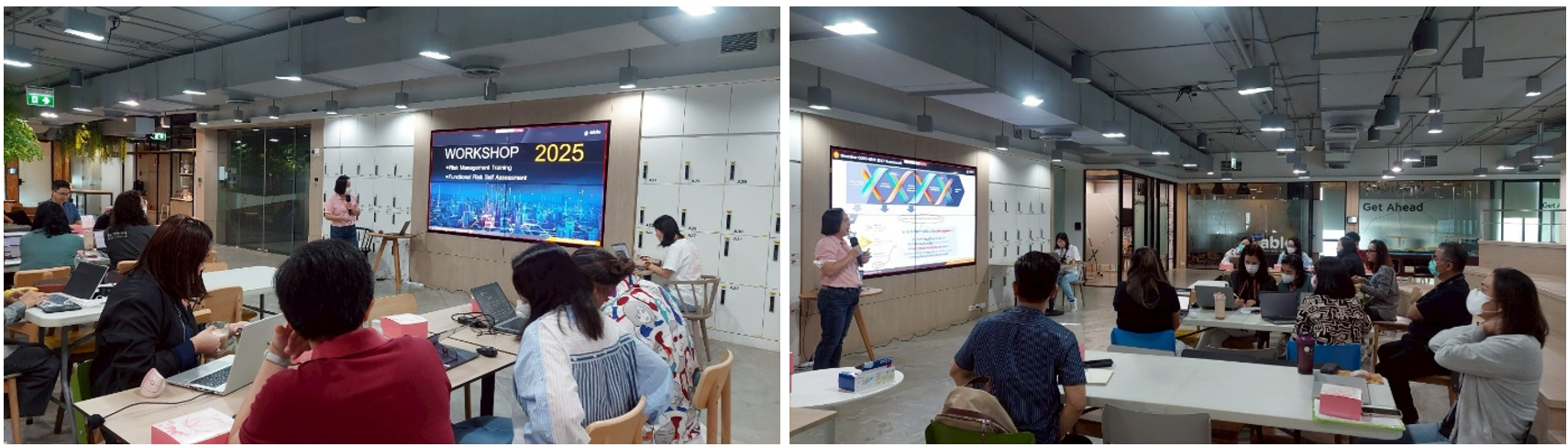
In 2025, the Company organized training sessions and seminars to educate employees on risk management, covering an overview and the importance of risk management, risk management processes, risk management tools, and risk management reporting. Workshops were conducted for representatives from various departments to assess their respective functional risks. In addition, the Company, through the Risk Management Working Team, has reviewed its knowledge of overall risk management and processes with the Board of Directors and senior executives, including holding knowledge-sharing sessions on ESG risk and corruption risk.
Furthermore, the Company has implemented business continuity management to ensure its ability to operate continuously and sustainably. The business continuity plan is regularly updated and tested to enhance the capability to effectively respond to emergency situations that may disrupt business operations, such as natural disasters, pandemics, or civil unrest.
Policy Document Link
https://investor.g-able.com/storage/download/sustainability/cg/policy/20260114-gable-enterprise-risk-management-policy-en.pdf
Risks to the Company's Business Operations
Risk Register
| Risk Name | Risk Characteristics | Consequences | Management Measures | Related Risk Factors |
|---|---|---|---|---|
| Risk from Technological Changes | The businesses of the Group are closely related to technology, which undergoes rapid development and changes. | If there are technological changes and the Group cannot keep up with and adapt to these changes promptly to meet customer needs, it may result in the loss of customer base and potentially impact on the operations of the Group. | The Group is well-prepared to adapt to ongoing technological changes. The management of the Group, with over 36 years of expertise in the technology business, possesses a deep understanding of the industry. Additionally, the Group has established partnerships with several world-leading product owners, resulting in continuous support in terms of knowledge transfer and information sharing regarding technological trends and changes. Moreover, the Group actively encourages its executives and staff at all levels to closely follow information and news related to the development of new technologies. This includes regular participation in seminars and training sessions organized by product owners. This proactive approach ensures that the Group can swiftly adapt its service offerings to stay current with technological changes and meet the evolving needs of its customers promptly. Lately, the Company has foreseen a continuous growth trend in the demand for technology-driven data management solutions among leading enterprise customers, particularly through cloud-based technologies. To accommodate this technological shift, the Company has positioned itself as a comprehensive cloud service provider, offering consulting, design, implementation, and maintenance services for various cloud systems. This enables enterprise customers to effectively leverage cloud solutions that meet the diverse needs of their businesses. Moreover, the Company has made its cloud, cybersecurity, data and analytics, and managed tech services available on the AWS Marketplace, making them even more accessible to customers. | 729 · Description: Behavior or needs of customers / consumers · Info category: STRATEGIC_RISK · 739 · Description: Shortage or reliance on skilled workers · Info category: OPERATIONAL_RISK · 732 · Description: Changes in technologies · Info category: STRATEGIC_RISK · 1725 · Description: Income volatility · Info category: FINANCIAL_RISK |
| Risk from Business Competition | The Group engages in the business of providing information technology and digital solutions, which is a highly competitive business. Each service provider always strives to create differentiation from competitors to gain a competitive advantage, including forming partnerships with globally recognized technology developers to access cutting-edge technology, developing their own solutions to meet customer demands, and entering price war to increase market share, given customers’ limited budgets. These may result in intensified competition within the industry. | Increased business competition may adversely affect the Group’s operations and profitability. | The Group uplifts its competitiveness with its comprehensive information technology and digital solutions, including its specialization and experience from over 36 years of business operations, as well as its continuous development of proprietary products, both digital marketing platform, space management platform, and big data management platform, to strengthen its competitive advantage. In 2025, the Group launched CorpGPT platforms, namely GENA and Allyx, as assistants designed for enterprises seeking to adopt Generative AI within their operations. These platforms are tailored to various business use cases, enabling secure, systematic, and fully controlled utilization. GENA and Allyx were developed to empower enterprises to maximize the potential of Generative AI, enhancing agility and creating opportunities to reduce operating costs. In addition, the Group employs cost and expense management strategies, along with investments in high-potential and high-margin businesses, as measures to mitigate this risk. In early 2025, the Group also implemented an organizational restructuring to enhance operational efficiency going forward. For Round 2 Solutions Company Limited (“R2”), in which the Company invested in August 2024 by acquiring 75 percent of its ordinary shares to strengthen capabilities and enhance the comprehensiveness of the Group’s business solutions, its performance has achieved the determined targets. Moreover, the Company analyzes overall business competition and sets the standard price of the Group, which is monitored and reviewed regularly, to allow the Group to remain competitive in pricing against business competitors. The Company therefore believes that it can manage this risk factor at an acceptable level, as reflected in its ability to maintain a healthy gross profit margin. The gross profit margins for 2023 to 2025 were 20.60 percent, 18.53 percent, and 20.63 percent, respectively. | 1714 · Description: Competition risk · Info category: STRATEGIC_RISK |
| Risk from Relying on Some Customer Group | From 2023 to 2025, the Group had the service income from serving customers in the financial and banking segment, insurance segment, and securities companies segment, accounting for 42.90 percent, 47.90 percent, and 40.04 percent of the total sales and service revenue, respectively. These segments represent major customer groups for the Group. | In the event of significant adverse events affecting industries of the Group’s major customers, such as changes in economic factors, changes in consumer behavior, or regulatory changes specific to these sectors, there may be an impact on information technology investment by this industry group, potentially affecting the performance of the Group. | The Company has a policy to expand its customer base to other industries, aiming to reduce risk and enhance the potential for revenue and profitability growth of the Group. In this respect, the Group aims to address the current business needs to enhance sales opportunities by integrating solutions that provide a competitive advantage, such as expanding consulting services and implementing business applications, including HCM (Human Capital Management), ERP (Enterprise Resources Planning), and CRM (Customer Relationship Management) systems, for enterprises, as well as forming partnerships with global consulting firms to introduce solutions aligned with IT industry trends to further expand the customer base. In 2025, the Company signed a comprehensive business collaboration agreement with Thai NS Solutions Company Limited (an affiliate of NS Solutions Corporation, Japan, and one of shareholders of R2), to enhance its capabilities and potential in providing digital solutions to a broader customer group, particularly within the manufacturing sector. Consequently, the service income from serving customers in the manufacturing and energy segment accounted for 11.44 percent of the total sales and service revenue, increasing by 20.75 percent from 2024. | 734 · Description: Reliance on large customers or few customers · Info category: STRATEGIC_RISK · 755 · Other name: Customer concentration · Description: Other · Info category: OPERATIONAL_RISK |
| Risk from Relying on Product Vendors | In a part of selling and providing information technology and digital solutions to customers, the Group relies on products ordered from manufacturers or distributors as a solution component, especially for a Value-added Distribution Solution operated by First Logic Company Limited ("FLG"), a subsidiary of the Company. FLG operates as a Value-added Distributor for Oracle Corporation ("Oracle"), a globally recognized technology developer for organizational-level usage. In 2023 to 2025, the Group had revenue derived from Oracle products, accounting for 22.13 percent, 18.10 percent, and 17.71 percent of the total sales and service revenue, respectively. | In the future, if the manufacturers or distributors of solution components, including Oracle, change their business models and policies, and/or if there are additions or reductions in distributors, and/or if the pricing of products that form part as a solution component, it may materially affect the Group’s revenue and performance. | The Group has maintained a strong and continuous relationship with manufacturers or distributors of solution components, especially Oracle which FLG holding the right to act as an Oracle distributor in Thailand for over 15 years, starting from 1990 onwards. In addition, the Group also has a policy to maintain relationships with other product owners to mitigate the risk of excessive reliance on any product owner. Currently, the Group has received high-level partnership certifications from widely recognized global product owners, such as Dell Technologies - Platinum, Hewlett Packard Enterprise - Gold, Oracle - Oracle Partner Network and Red Hat - Advanced Business Partner. | 735 · Description: Reliance on large partners / distributors or few partners / distributors · Info category: STRATEGIC_RISK · 755 · Other name: Dependence on product vendors · Description: Other · Info category: OPERATIONAL_RISK |
| Risk from Relying on Specialized Personnel | Due to the nature of business of information technology and digital solutions, it relies on personnel with expertise and experience, as well as possessing in-depth knowledge of technologies, which continue to evolve rapidly, and having a good understanding of customer operations. Therefore, the majority of the Group's workforce, especially those in solution and technology-related positions, must be knowledgeable and deeply understand the relevant technologies to efficiently offer solutions that meet customer needs. This includes providing high-quality after-sales services. | If the Group cannot retain experienced and skilled personnel, it may impact on the Group’s services and ultimately affect its operational performance. | The Group places an importance on human resource management and supports employees at all levels with continuous skill development and knowledge enhancement. Moreover, the Group has a policy to promote employee development through training and certification programs provided by product owners who are partners with the Group. Simultaneously, the Group provides suitable compensation and welfare, while supporting work-life balance through a hybrid workplace model. The Group also designs various programs to support employees’ physical and mental well-being, promoting a positive and fulfilling work environment. All of these are for motivating and retaining its workforce to continue working with the Group. Furthermore, to create motivation among the employees within the Group, the Company has issued and offered warrants to purchase the shares of the Company to the executives (including those who took the position of director) and/or employees of the Company and/or its subsidiaries under GABLE ESOP-W1 scheme. This is to allow the Group’s executives and employees to become owners of the Company for the purpose of fostering joint development to sustainable growth aligned with the business plan. Further details can be considered in 1.5 Issuance of other securities. In addition, the Group has established processes to ensure continuity in key positions within the Group through clear and adequate workforce planning. The Group also enhances its recruitment strategies, including collaborating with universities to develop academic curricula and learning activities, to bring in high-quality individuals to join the Group team in a timely manner that aligns with the growth direction of the Group. Additionally, the Group has put in place contingency plans for situations where senior executives of the Group are suddenly unable to perform their duties by outlining them in the Company’s business continuity plan to prevent business disruption. Succession plans for crucial positions have been developed by preparing mid-level executives to be capable and ready to take on high-level managerial positions in the future. Clear criteria and procedures are in place to ensure that the selection of personnel for key positions is conducted appropriately and transparently. This is to ensure that the Group maintains a workforce with the necessary qualifications, abilities, and experience to support sustainable growth in the long term. | 738 · Description: Reliance on employees in key positions · Info category: OPERATIONAL_RISK · 739 · Description: Shortage or reliance on skilled workers · Info category: OPERATIONAL_RISK |
| Risk from Cybersecurity Treats | The current business operations increasingly rely on information technology systems, whether for internal communication within the organization or transactions with customers. Simultaneously, the rates of cybercrimes and data breaches, such as phishing, malware, and viruses, have become more diverse and complex. Therefore, cyber threats can have wide-ranging impacts on businesses, including business interruptions and loss of intellectual property or trade secrets. | This risk may result in reputational damage, service disruptions, a loss of stakeholder confidence, and adverse impacts on the performance of the Group. | The Company is aware of the risk associated with cybersecurity treats. The policies regarding IT and data securities incorporating (a) restricted access controls based on employees’ roles and responsibilities and (b) identity verification and authentication by utilizing two-factor authentication as key guidelines have been established. These policies are regularly reviewed by the Board of Directors. In addition, the Company has taken steps to enhance cybersecurity measures throughout the organization. This includes engaging external experts to conduct detailed cybersecurity system audits; establishing a dedicated Security Operations Center (SOC) with a 24/7 operational support plan to handle and prevent cybersecurity threats across computer systems, user accounts, and data; and deploying daily cybersecurity risk assessment software to evaluate security performance. Online cybersecurity awareness training is also provided for employees. In 2025, the Group conducted two penetration tests to assess the robustness of its computer systems. Furthermore, the Group has obtained ISO 27001 certification, the international standard for Information Security Management Systems (ISMS), which reinforces data security, reduces risks, and safeguards information from unauthorized access, thereby strengthening confidence in the Group’s information technology systems. | 744 · Description: Information security and cyber-attack · Info category: OPERATIONAL_RISK · 736 · Description: Damage to company image and reputation · Info category: STRATEGIC_RISK · 1720 · Description: System disruption risk · Info category: OPERATIONAL_RISK |
| Risk from Fluctuation of Currency Exchange Rate | The Group is exposed to currency exchange rate risk as some of its products need to be purchased from manufacturers or distributors in U.S. dollars, while, most revenue from sales and service is denominated in Thai Baht (although the Group generates some revenue in U.S. Dollars from the operations). As a result, the Group has obligations to make payments in foreign currencies. Meanwhile, the re-election of Mr. Donald Trump as President of the United States and the U.S. foreign trade policies have heightened global trade tensions, causing increased volatility in foreign exchange rates, particularly U.S. Dollar. | Fluctuations in exchange rates, especially if U.S. Dollar strengthens, may impact on the costs of the Group, potentially affecting the Company’s operations. | The Group recognizes the importance of the risk and has a policy in place to set prices, considering the risk from currency exchange rate fluctuations. This allows the Group to appropriately set prices aligned with project costs to some extent. Additionally, the Group closely monitors economic conditions, foreign trade policies, and economic policies (particularly the policies of the Thai government on negotiating international trade agreements), as well as movements in currency exchange rates. The Group will also consider hedging its exposure through forward contracts as necessity based on circumstances. As of 31 December 2025, the Group has a total forward contract amount of THB 1,118.51 million (based on the average selling exchange rate on the last day of the year, as of 31 December 2025, as announced by the Revenue Department, at THB 32.9494 per U.S. Dollar). Excluding gains or losses from the fair value adjustment of forward contracts, the Group recorded losses from exchange rate fluctuations of THB 2.43 million in 2023 and THB 4.82 million in 2025, while profit of THB 2.18 million in 2024. | 764 · Description: Fluctuation in exchange rates, interest rates, or the inflation rate · Info category: FINANCIAL_RISK |
| Risk from Late Delivery of Deliverables | Most of the work for which customers engage or procure services from the Group has clearly defined and firm delivery timelines. The duration for each engagement depends on the size and complexity of the project. | If the Group is unable to perform in accordance with the required standards, deliver work within the contractual timeline, or meet the agreed-upon contractual obligations, it may undermine customers’ confidence in the quality of products and services, as well as project management effectiveness. The Group may also be liable for penalty charges imposed by customers, which could adversely affect its performance. | The Group always prioritizes delivery of deliverables with standards and meeting the customer requirements. In project operations, there are the Project Management Department responsible for closely overseeing and controlling the project's progress throughout its duration. This includes managing and scheduling project timelines to align with the specified deadlines and ensuring the systematic and continuous delivery of work to customers. This approach enables the Company to address any issues swiftly and on time without adversely affecting the overall project. In this respect, from 2023 to 2025, the Group incurred penalty fees totaling THB 0.31 million, THB 0.96 million, and THB 0.08 million, respectively. | 767 · Other name: Returns that fall short of projections · Description: Other · Info category: FINANCIAL_RISK · 755 · Other name: Failure to execute customer projects as planned · Description: Other · Info category: OPERATIONAL_RISK |
| Risk from Climate Change (emerging risk) | (a) Global boiling and natural disaster, including heat waves, floods, landslides, soil erosion, and air pollution caused by human activities, such as PM 2.5; and (b) uncertainty and risk associated with regulatory changes, including the Thailand Climate Change Act, currently under consideration by the relevant authorities, which aims to achieve net-zero greenhouse gas emissions as its core objective | Employee health and well-being, deterioration of electronic devices due to extreme heat, delays in the transportation of goods and equipment within the supply chain leading to project delivery falling behind schedule, and cost increases if the Group continues to operate without a decarbonization strategy when the Climate Change Act comes fully into effect | The Group (a) continuously implements hybrid workplace model to help reduce pollution generated from employee commuting, while also safeguarding employee health and well-being from potential air pollution exposure during travel; (b) establishes systematic guidelines for the maintenance of electronic equipment storage facilities to slow the deterioration of electronic devices; (c) demonstrates its commitment to reducing greenhouse gas emissions in accordance with carbon footprint standards and the requirements of the Thailand Greenhouse Gas Management Organization (Public Organization) by setting clear targets and communicating them to stakeholders; and (d) closely monitors developments, assesses evolving situations, and considers additional regulations and measures related to greenhouse gas emission reduction. Remark: ESG risk - Risk in environmental aspect | 742 · Description: Human error in business operations · Info category: OPERATIONAL_RISK · 760 · Other name: Enforcement of environmental laws · Description: Other · Info category: COMPLIANCE_RISK · 750 · Description: Climate change and disasters · Info category: OPERATIONAL_RISK · 755 · Other name: Environmental-related risks · Description: Other · Info category: OPERATIONAL_RISK |
| Risk from Global Geopolitical Conflicts | Political polarization between powerful countries and tensions in regions | Economic stability which may influence or delay investment decisions in the Group’s products and services, exchange rate fluctuations, uncertainty in cost increases driven by various factors such as supply chain changes and tax burdens, and delays in sourcing or repairing goods and equipment due to transportation constraints and supply chain disruptions | The Group monitors global changes and analyzes potential impacts comprehensively to develop strategic plans that minimize risks and adverse effects on the Group’s operations and financial performance to the lowest possible level. Remark: ESG risk - Risk in economic aspect | 737 · Other name: Global geopolitical conflicts and economic uncertainties · Description: Other · Info category: STRATEGIC_RISK |