

CG Policy · 2025
In this section7 topics
Corporate Governance Policy
Has a Corporate Governance Policy
Yes
Policy Description
G-Able Public Company Limited (the "Company") is aware of the importance of having a good corporate governance system, which is crucial for promoting the Company's operations to be efficient, leading to maximum benefits for all stakeholders. Therefore, the Board of Directors deems it necessary to establish policies related to corporate governance (including but not limited to corporate governance policy, charters of the Board of Directors and sub-committees, code of conduct and business ethics, inside information retention and protection policy, and policy on conflicts of interest prevention and declaration of interests) to ensure clarity, consistency, and enforceability so as to allow the Board of Directors, executives, and employees to act in the same direction. These policies related to corporate governance cover key principles from the structure, roles, and responsibilities of the Board of Directors to business management. Corporate governance should be transparent, clear, and auditable to instill confidence that the Company's operations are conducted fairly and in the best interests of all stakeholders. The Board of Directors and executives of the Company are committed to adhering to these business principles with dedication and integrity, with established visions, policies, and practices that the Board of Directors, executives, and employees adhere to in fulfilling their responsibilities to promote continuous good corporate governance practices, creating added value for stakeholders to achieve the objectives set by the Board of Directors in structuring the organization to be transparent and able to audit work clearly.
The Board of Directors emphasizes the importance of adhering to good corporate governance principles. They recognize the roles, duties, and responsibilities of the Board of Directors and management in promoting good corporate governance to enhance the Company's competitiveness and instill confidence in shareholders, investors, and stakeholders. Through effective and transparent management, policies are established to support operations in line with good corporate governance principles, covering key practices and guidelines as outlined in the Corporate Governance Code for Listed Companies 2017, as prescribed by the Securities and Exchange Commission (the "SEC").
(1) Understanding the role and responsibilities of the Board of Directors as organizational leaders who sustain long-term value creation for the business
(1.1) The Board of Directors comprehends its role and responsibilities as leaders tasked with overseeing effective management. The Company defines the roles, authorities, and responsibilities of the Board of Directors clearly, covering aspects such as strategy formulation, objectives, policy setting, resource allocation, monitoring, evaluation, and performance reporting.
(1.2) In the pursuit of value creation, the Company has developed a code of conduct and other policies that outline principles and guidelines for operation in written. These serve as standards for directors, executives, and employees, ensuring effective communication, adequate mechanisms for policy implementation, monitoring, and regular policy review and adherence. The Company disseminates these policies through its website and conducts training for directors, executives, and employees.
(1.3) The Company appoints the Audit Committee and internal audit unit to ensure compliance with relevant laws, regulations, and meeting resolutions. It has mechanisms for receiving and addressing complaints and investigates cases of corporate misconduct. Additionally, it has approval processes for significant operations, including investments, material transactions, connected transactions, asset acquisition and disposal transactions, all aimed at maximizing benefits for shareholders and building trust for business operations.
(1.4) The Board of Directors understands its duties and responsibilities by establishing charters for the Board of Directors and sub-committees. These charters serve as references for the Board of Directors and sub-committees, with regular reviews conducted at least annually to align with the organization's direction and operations.
(2) Setting objectives and main goals for business operations
(2.1) The Board of Directors gives importance to setting objectives and main goals for the business and communicating them to all stakeholders to create understanding and alignment. This includes ensuring that employees adhere to these objectives and goals in their duties to achieve the Company's defined objectives and goals. Considerations include readiness, competence, competitiveness, environmental factors, and changes in various factors, as well as the appropriate use of innovation and technology to foster sustainability and the Company's growth.
(2.2) The Board of Directors has established strategies and annual plans that align with the Company's objectives and main goals, taking into account environmental conditions and various factors and risks that may affect stakeholders. Additionally, they are aware of the risks associated with setting targets that could lead to legal violations or ethical breaches. Regular monitoring of strategy implementation and annual plans is conducted to ensure appropriate resource allocation and operational control according to the established plans.
(3) Fostering the effective Board of Directors
(3.1) The Board of Directors has the responsibility to establish and review the structure of the Board of Directors, including their composition, size, and the proportion of independent directors, which should not be less than 3 persons and no less than one-third of the total number of directors. This ensures an appropriate balance, taking into consideration attributes such as gender, skills, experience, and abilities. A board skill matrix is prepared to ensure confidence that the overall structure of the Board of Directors has suitable qualifications, can meet the needs of stakeholders, and effectively perform its duties.
(3.2) The Company requires that the Chairman of the Board of Directors shall not be the same person as the Chief Executive Officer, with distinct roles and responsibilities. The Board of Directors specifies the duties of the Chairman of the Board of Directors and the Chief Executive Officer clearly, ensuring no individual has unlimited authority. If the Chairman of the Board of Directors is not an independent director, the Chairman of the Audit Committee, as an independent director, shall be assigned to participate in setting the meeting agenda with the Chairman of the Board of Directors. Additionally, the Company has a policy limiting the continuous tenure of independent directors to a maximum of nine years from the date of their initial appointment. The reappointment of an independent director beyond this tenure requires careful consideration with reasonableness by the Board of Directors.
(3.3) The Board of Directors has established the Nomination and Remuneration Committee, with a chairman who is an independent director and not the same person as the Chairman of the Board of Directors, to assist in considering criteria and methods for selecting suitable individuals to serve as the Company's directors, taking into consideration qualifications, skills, knowledge, abilities, and relevant experience, along with a review of the individual's background. Recommendations are then presented to the Board of Directors' and/or shareholders' meeting for further consideration.
(3.4) The Board of Directors will receive remuneration as approved at the shareholders' meeting. In determining directors' remuneration, the Board of Directors shall take into account the duties, responsibilities, and performance of the directors that contribute to the benefit of the Company.
(3.5) The Board of Directors must adhere to the Code of Best Practices for Listed Companies set forth by the Stock Exchange of Thailand (the "SET") and promote understanding among all directors of their roles, duties, responsibilities, and compliance with the laws, objectives, and regulations of the Company, as well as resolutions passed at shareholders' meetings with honesty, integrity, and considering the interests of the Company and shareholders. Additionally, the Company has set criteria for holding positions in other companies for directors to ensure that they can allocate sufficient time to fulfill their duties within the Company. Directors are allowed to hold director positions for up to 5 listed companies, both in the SET and the stock exchange in any country (including positions within the Company). This is to ensure that all directors can dedicate adequate time to fulfill their responsibilities effectively. Furthermore, the Company encourages directors to attend meetings, representing at least 75 percent of all meetings held each year.
(3.6) The Company provides orientation for newly appointed director to introduce useful information for his/her duties, including understanding the objectives, main goals, vision, mission, corporate values, as well as the nature of the business and business guidelines of the Company. Furthermore, the Company encourages its directors to participate in seminars and training courses related to their duties and the Company's business operations.
(3.7) The Board of Directors oversees to ensure that the Board of Directors' performances are conducted smoothly, and that there is the Company Secretary with the necessary knowledge and experience to adequately support the Board of Directors' performances.
(4) Recruitment and development of senior executives and human resource management
(4.1) The Board of Directors ensures that there is recruitment and development of the Chief Executive Officer and senior executives with the necessary knowledge, skills, experience, and characteristics essential for driving the organization towards its goals.
(4.2) The Board of Directors shall oversee the establishment of a compensation structure and appropriate performance evaluation procedures.
(4.3) The Board of Directors shall consider and understand the structure and relationships of shareholders that may impact the management and operations of the business, and shall ensure that such structure and relationships do not hinder the duties of the Board of Directors. The Company also has policies to disclose information according to agreements that affect business operations (if any).
(4.4) The Board of Directors shall monitor and oversee the management and development of personnel to ensure that they have the necessary knowledge, skills, experience, and appropriate motivation. There will be established a compensation structure that aligns with the knowledge, abilities, and responsibilities of positions, along with a system for fair wages, compensation, and benefits for employees, ensuring rights and appropriate welfare in accordance with labor laws. The Company will maintain a safe working environment for the life, health, and property of employees, as well as establish channels of communication between employees and supervisors or managers. Furthermore, support will be provided for development processes and skills enhancement through internal and external training programs as necessary and appropriate, to continuously and consistently develop and reinforce the knowledge and abilities of employees.
(5) Promoting innovation and conducting business with responsibility
(5.1) The Board of Directors places importance on and supports innovation that creates value for the business while also benefiting customers or stakeholders. Moreover, they have a responsibility towards society and the environment to ensure a balance between business profitability and societal contributions.
(5.2) The Board of Directors is aware of the rights of all stakeholders, whether they are internal or external stakeholders. This is to foster mutual understanding and cooperation between the Company and its stakeholders, which will benefit business operations and build confidence. Additionally, it enhances the Company's long-term competitiveness. Therefore, the Company has established practices towards various stakeholder groups.
(5.3) The Board of Directors is responsible for setting policies, business objectives, business plans, and budgets for the Company. They also oversee the management's implementation to ensure alignment with established policies, plans, and budgets for the maximum benefit of the Company and its shareholders. Regular reviews of these business plans and budgets are conducted to monitor and ensure efficient allocation and management of the Company's resources. This is being done to achieve results in line with the Company's objectives and main goals.
(5.4) The Board of Directors oversees the enterprise risk management, including the management and handling of information technology risks. They ensure that there are adequate measures in place to manage the security of information systems to a sufficient standard for the benefit and business effectiveness of the Company.
The IT system security policy therefore has been established to define guidelines for the use and management of information technology within the Company's group, ensuring systematic efficiency with security measures to prevent unauthorized data access, cyberattacks, and critical data loss. This policy will be reviewed by the Board of Directors annually. In this regard, the Company has implemented the best practices in line with international standards under the Information Security Management System (ISMS) framework. This ensures that the Company's information security management is both effective and suitable for its business operations. As a result, the Company has been certified with ISO 27001: Information Security Management System by TUV NORD CERT GmbH, Germany.
The key practices implemented to ensure the security of the Company's information systems include (i) access control and data protection, such as restricted access based on employees' roles and responsibilities and identity verification and authentication by utilizing two-factor-authentication, (ii) data classification, considering risk levels to security, business value impact, and potential loss to the Company, (iii) personal data management for all stakeholders, including customers, suppliers, and employees, in compliance with personal data protection laws1, (iv) incident response measures, such as clear contingency plans, regular security drills, continuous employee cybersecurity awareness training, and (v) conducting vulnerability assessments and penetration testing of the Company's information systems at least once a year.
1 Data retention policy, including channels and processes for handling customer complaints regarding personal data can be found at https://investor.g-able.com/storage/download/sustainability/cg/policy/20250116-gable-data-privacy-policy-en.pdf.
Additionally, the Company manages cybersecurity risks and risks involved in security of personal data storage, processing, and transfer at an acceptable level. The Company has implemented preventive measures and close monitoring of cyber threats, including establishing a Security Operations Center responsible for monitoring and analyzing cybersecurity threats 24/7, conducting cyber drill campaigns to simulate cyberattack scenarios, and using daily cybersecurity risk assessment software to evaluate security performance, which its assessed daily score is set as a key risk indicator. In 2025, the Company enhanced cybersecurity and data protection awareness among executives and employees by conducting training courses. Between 16 October 2025, and 15 December 2025, 98.27 percent and 98.20 percent of the required 1,464 employees successfully completed cybersecurity awareness course and personal data protection awareness course, respectively. To pass the courses, employees were required to score above 80 percent on the end-of-course assessment. Moreover, there were no reported complaints from any stakeholders regarding personal data.
(6) Ensuring appropriate system for risk management and internal control
(6.1) The Board of Directors oversees to ensure that the Company has risk management and internal control systems in place to effectively achieve its objectives and comply with relevant laws and standards.
(6.2) The Board of Directors appoints the Audit Committee comprised at least three members, all of whom must be independent directors and possess qualifications and duties according to the criteria set by the SEC and the SET. The Audit Committee should have access to necessary information to fulfill its duties and may consult with other professional advisors to seek independent opinions as needed. Additionally, the Audit Committee must assess the adequacy of the Company's risk management and internal control systems and disclose its findings in the Company's annual report.
(6.3) The Board of Directors establishes policies regarding potential conflicts of interest that may arise between the Company and management, the Board of Directors, or shareholders. This includes preventing undue use of the Company's assets, information, and opportunities, as well as transactions with related parties for the best interests of the Company and its shareholders. Importantly, a person having conflicts of interest shall not be involved in decision-making.
(6.4) The Company has developed an anti-corruption policy, which outlines clear measures and practices to combat corruption. This policy is communicated at all levels within the organization and to external parties to ensure it can be effectively implemented by all stakeholders.
(6.5) The Company has implemented a policy on whistleblowing, which includes mechanisms for receiving complaints, conducting investigations in cases of allegations, and protecting whistleblowers or complainants. This ensures that no unfair treatment is taken against whistleblowers or complainants, and their identities, including names, addresses, and any other identifying information, are not disclosed.
(7) Maintaining financial credibility and information disclosure
(7.1) The Board of Directors is responsible for overseeing that the financial reporting system and disclosure of key information are accurate, adequate, timely, and in compliance with relevant regulations, standards, and practices.
(7.2) The Company will ensure that there is oversight to track and evaluate the financial status of the Company, and regular reporting to the Board of Directors. Both the Board of Directors and the management will collaborate to address financial liquidity issues and debt repayment capabilities. Moreover, in approving any transactions or offering opinions at shareholders' meetings, the Board of Directors will ensure that such actions do not impact the continuity of business operations, financial liquidity, or debt repayment capabilities of the Company.
(7.3) The Board of Directors emphasizes the importance of managing financial issues while considering the rights of all stakeholders. In cases where the business is trending towards an inability to repay debts or faces financial difficulties, the Board of Directors will closely oversee the management to ensure that the business is conducted prudently. They will monitor the progress of financial problem-solving closely, with regular financial status reports from management. This oversight aims to ensure that any decisions made to address financial issues are reasonable and fair to all stakeholders. Plans to address financial problems will be developed with consideration for the fairness to all stakeholders. Additionally, the Company will adhere to disclosure requirements to ensure that shareholders are fully informed of relevant information.
(7.4) The Company ensures transparency by disclosing information about compliance with laws, ethical standards, anti-corruption policy, treatment of employees and stakeholders, including fair practices and respect for human rights. Additionally, it emphasizes responsibility towards society and the environment. This disclosure is based on internationally accepted reporting frameworks, and the disclosed information reflects practices aimed at value creation for the business.
(7.5) The Board of Directors has overseen the management for the establishment of a unit or responsible personnel for investor relations to ensure that investor relations activities, such as communication with shareholders and other stakeholders like investors and analysts, are conducted appropriately, equitably, and in a timely manner.
(7.6) The Company ensures that information is disclosed in both Thai and English through its website. Furthermore, it consistently presents up-to-date information to stakeholders.
(8) Supporting involvement and communication with shareholders
(8.1) The Company is aware of the importance of the rights of every shareholder, whether they are major shareholders, minor shareholders, Thai nationals, foreigners, individuals, or institutional shareholders, who have ownership rights by controlling the Company through the appointment of directors to represent them and have the right to make decisions regarding significant changes in the Company. Therefore, the Company promotes and supports shareholders to exercise their rights and receive equal basic protection, including trading or transferring shares, receiving a share of the Company's profits, obtaining sufficient information about the Company's affairs, and participating in shareholders' meetings to exercise voting rights.
(8.2) The Board of Directors will ensure that shareholders' meetings are conducted smoothly, transparently, efficiently, and facilitate shareholders' exercise of their rights. This includes scheduling meetings at suitable dates and times, allocating sufficient time for meetings, and ensuring that meeting venues are easily accessible, with maps attached to the meeting invitations for physical meetings. For electronic shareholders' meetings, the Company will use a system that shareholders can easily access and that meets relevant standards and criteria.
(8.3) The Board of Directors will ensure that resolutions and voting results from the meetings are disclosed through the SET's website and the Company's website within the next business day. Additionally, they will oversee the delivery of meeting minutes to the SET and ensure that they are published on the Company's website within 14 days from the date of the shareholders' meeting. They will also supervise the preparation of the shareholders' meeting minutes to ensure accuracy and completeness.
Policy Document Link
https://investor.g-able.com/storage/download/sustainability/cg/policy/20260114-gable-corporate-governance-policy-en.pdf
Policy & Practices — Board of Directors
Has Policy & Guidelines for the Board
Yes
Board Guidelines
| Guideline | Detail | Document Link | Page Number in Report |
|---|---|---|---|
| Nomination of Directors | The selection of individuals to be appointed as directors is assigned to the Nomination and Remuneration Committee by the Board of Directors. The Nomination and Remuneration Committee is responsible for selecting individuals who possess the qualifications required by securities and exchange laws, as well as other relevant laws, and who meet the criteria set forth by the Company, and then presents its recommendations to the Board of Directors and/or the shareholders’ meeting for consideration and appointment, as stipulated in the Company's articles of association. The criteria and methods for the nomination of director, as well as the election and/or appointment process, begin with the Nomination and Remuneration Committee reviewing the qualifications and diversity of skills, knowledge, expertise, and experience of directors, as well as overall composition through skill matrix, ensuring alignment with the Company's business strategy and direction. This skill matrix is conducted without limitations based on gender, race, religion, age, and specific abilities, and includes devoting time to fully perform duties. In the appointment of a new director, the Nomination and Remuneration Committee considers the skill and expertise of each director through skills matrix to define the required qualifications, taking into account the necessary skills that may be lacking in the current Board of Directors, aiming to achieve diversity within the structure. Additionally, the Nomination and Remuneration Committee may consider candidates from (i) recommendations given by the executives, directors, and external individuals with credibility, (ii) the director pool database or (iii) data from a professional search firm. Moreover, the Nomination and Remuneration Committee welcomes suggestions from minority shareholders proposing individuals for considering and appointing as director during the general meetings of shareholders, following the Company’s defined criteria. At the shareholders’ meeting, the election of directors will be conducted by using the majority votes of the shareholders attending and voting, following the criteria and methods specified in the Company's articles of association as follows: (a) Each shareholder is entitled to one vote for each share they hold. (b) Each shareholder may use the total number of votes to elect one or several candidates as directors. If several candidates are to be elected as directors, the votes may not be split among candidates. (c) In descending order, the candidates with the most votes will be elected as directors. Directors must be elected in the number of available seats at that meeting. The chairman has one casting vote if the candidates in the next lower ranking of votes have an equal number of votes and the number of available seats at the meeting is exceeded. | https://investor.g-able.com/storage/download/sustainability/cg/policy/20260114-gable-corporate-governance-policy-en.pdf | 7 |
| Determination of Director Remuneration | The Board of Directors will receive remuneration as approved at the shareholders' meeting. In determining directors’ remuneration, the Board of Directors shall take into account the duties, responsibilities, and performance of the directors that contribute to the benefit of the Company. Directors with increased responsibilities shall receive remuneration commensurate with the additional duties and responsibilities assigned to them. The Board of Directors has delegated responsibility to the Nomination and Remuneration Committee to consider the remuneration rates for the Board of Directors, sub-committees, the Chief Executive Officer, and the C-level executives for presentation to the Board of Directors and/or shareholders' meeting, as applicable. Criteria for remuneration determination are as follows: (a) Remuneration aligns with the Company's long-term strategy and objectives, as well as the roles, responsibilities, and accountability of directors. (b) Remuneration is sufficient to motivate and retain knowledgeable, skilled, and high-quality directors who effectively perform their duties. (c) Remuneration compositions are clear, transparent, and easily understandable, both in monetary and non-monetary terms. (d) Remuneration rates can be benchmarked against other companies in the same or similar industries. Details of directors’ remuneration can be found in section 8.1.2 Meeting attendance and remuneration payment to each board member. | https://investor.g-able.com/storage/download/sustainability/cg/policy/20260114-gable-corporate-governance-policy-en.pdf | 7-8 |
| Independence of the Board of Directors from the Management | The Company requires that the Chairman of the Board of Directors shall not be the same person as the Chief Executive Officer, with distinct roles and responsibilities. The Board of Directors specifies the duties of the Chairman of the Board of Directors and the Chief Executive Officer clearly, ensuring no individual has unlimited authority. If the Chairman of the Board of Directors is not an independent director, the Chairman of the Audit Committee, as an independent director, shall be assigned to participate in setting the meeting agenda with the Chairman of the Board of Directors. As of 31 December 2025, Mrs. Supavadee Phantumvanit was the Chairman of the Board of Directors, who is not an independent director and is not the same person as the Chief Executive Officer. There is also no family relationship between them. The duties of the Board of Directors, the Chairman of the Board of Directors, and the Chief Executive Officer, including the delegation of authority, are clearly segregated and can be considered in 7.1 Corporate Governance Structure. | https://investor.g-able.com/storage/download/sustainability/cg/policy/20260114-gable-corporate-governance-policy-en.pdf | 6 |
| Director Development | The Company has a policy to encourage its directors to participate in seminars and training courses related to their duties and the Company's business operations, in order to enhance their knowledge and understanding of applicable laws, regulations, standards, risks, and the business environment, as well as to ensure that they are regularly kept up to date with current information. Accordingly, in 2025, the Company undertook the following initiatives: (a) reviewed knowledge on the overall framework and processes of the Company's risk management, including holding knowledge-sharing sessions on ESG risk, with the Board of Directors and senior executives to raise awareness of risk management as an integral part of the corporate culture; and (b) provided anti-corruption training to the Board of Directors, covering the Company's policies and procedures, key considerations and precautions, as well as the impacts and penalties associated with corruption, in order to ensure a thorough and genuine understanding. Details of training courses arranged by third party and attended by each director and senior executives, as defined by the SEC, can be found in Attachment 1: Details of directors, executives, controlling persons, the person assigned to take the highest responsibility in Accounting and Finance, the person assigned to take direct responsibility for accounting supervision, the Company Secretary, and the representative for contact and coordination in case of a foreign company. | https://investor.g-able.com/storage/download/sustainability/cg/policy/20260114-gable-corporate-governance-policy-en.pdf | 9 |
| Board Performance Evaluation | The Company shall conduct performance assessments of the Board of Directors and sub-committees at least once a year. This is to allow the Board of Directors to jointly assess performance and issues for ongoing improvement. Baselines will be established for comparison against performance criteria, and the evaluation results will be used to consider the suitability of board composition. Details of the performance assessments of the Board of Directors and sub-committees can be found in 8.1.1 Selection, development and evaluation of duty performance of the board of directors. | https://investor.g-able.com/storage/download/sustainability/cg/policy/20260114-gable-corporate-governance-policy-en.pdf | 9 |
| Corporate Governance of Subsidiaries and Associated Companies | (1) Policy on Investment in Subsidiaries and Associated Companies The Company has a policy to invest in businesses that align with the Company's goals, vision, and strategic plan for its growth that will contribute to increased business performance or profits, or synergy to enhance competitiveness, enabling the Company to achieve its goal of being a leading player in its core business. Additionally, the Company, its subsidiaries, and/or associated companies may consider investing in any additional businesses to achieve a favorable return on investment. With regard to consideration of investment by the Company, its subsidiaries, and/or associated companies, the Company shall conduct a thorough analysis of the investment's feasibility, considering potential and risk factors, with an appropriate investment analysis process. Approval for such investments must be obtained from the Executive Committee's meeting and/or the Board of Directors' meeting, and/or the shareholders' meeting (as the case may be). Moreover, any investment in subsidiaries and/or associated companies shall comply with relevant laws, regulations, announcements, and governmental orders. (2) Policy on Oversight of Operations in Subsidiaries and Associated Companies The Company has established a policy on oversight of operations in subsidiaries and associated companies with the objective of setting operational standards. This ensures that the Company can effectively supervise the management of its subsidiaries and associated companies, ensuring compliance with policies of the Company, including legal requirements, regulations, announcements, and governmental orders to maintain the proceeds in investments in subsidiaries and/or associated companies. Details of the oversight of subsidiaries and associated companies operations can be found in 8.1.3 Supervision of subsidiaries and associated companies. | https://investor.g-able.com/storage/download/sustainability/cg/policy/20260114-gable-corporate-governance-policy-en.pdf | 8 |
Code of Conduct
Has a Business Code of Conduct
Yes
Code of Conduct Description
The Company believes that the Code of Conduct and Business Ethics are important tools in promoting transparency in its operations to achieve the goal of growth and prosperity. Therefore, the Company has developed the Code of Conduct and Business Ethics to guide the conduct of directors, executives, and all employees. These guidelines are in line with the principles of good corporate governance, which are globally recognized management principles.
Code of Conduct Link
https://investor.g-able.com/storage/download/sustainability/cg/policy/20260114-gable-company-code-of-conduct-en.pdf
Code of Conduct Practices
| Guideline | Detail | Document Link | Page Number in Report |
|---|---|---|---|
| Prevention of Misuse of Inside Information | The Company operates its business by adhering to the guidelines of conducting business with honesty, transparency, integrity, and in accordance with the principles of good corporate governance, considering the interests of the Company as a priority. Therefore, a policy on prevention of conflicts of interest and report on interests has been established by outlining guidelines as follows: (a) Directors, executives and employees of the Company and/or its subsidiaries shall regularly assess themselves whether they have conflicts of interest in their discharge of duties. They shall avoid any actions that may lead to conflicts of interest with the Company and/or its subsidiaries. If it is necessary to do such a transaction, it shall be conducted on an arm’s length basis and in accordance with the Company’s connected transaction policy. (b) If directors, executives and employees of the Company and/or its subsidiaries discover they have interests or conflicts of interest, they shall refrain from performing the related tasks and shall report to their supervisors. Any directors or executives having interests shall submit the declaration of interests form to the Company Secretary who will compile the information and report it to the Chairman of the Board of Directors and the Chairman of the Audit Committee. (c) Director shall not engage or be a director of company, that is in business similar to, or in competition with, the Company’s business, whether for his/her own benefit or the benefit of others unless the shareholders are informed before being appointed as the Company’s director. (d) Directors shall not use the Company’s opportunities or inside information for personal gain or for any other person. (e) Directors and executives shall not participate in the meetings in agenda where they have interests or may cause conflicts of interest with the Company and/or its subsidiaries. (f) Directors and executives of the Company shall complete the declaration of interests form on an annual basis or when information has changed and submit to the Company Secretary to compile the information and report it to the Chairman of the Board of Directors and the Chairman of the Audit Committee. Details of the oversight of the compliance with the policy on conflict of interest can be found in 8.1.4 Monitoring of compliance with corporate governance policy and guidelines. | https://investor.g-able.com/storage/download/sustainability/cg/policy/20260114-gable-conflict-of-interest-en.pdf | |
| Anti-corruption | The Company established an Anti-corruption Policy with the objective of preventing any actions related to fraud and corruption in any form by the directors, executives, and employees of the Company, whether directly or indirectly, for their own benefit, their families, friends, or acquaintances, whether in the capacity of bribe recipients, providers, or offerors, in form of monetary or non-monetary, to government agencies or private entities whom the Company do business with. The scope and guidelines cover various business activities which can be summarized as follows: (a) Political contributions - the Company has a policy of not providing the political contributions, whether directly or indirectly, or engaging in activities that endorse any political party or political group. (b) Charitable contributions - it is considered as a part of corporate social responsibility activities. As such, to ensure that charitable contributions are conducted in a transparent manner, are not used as channels for fraud and corruption and are not made with expectation of any return benefit, the Company requires that charitable contributions shall be made in the Company’s name to certified, or reliable and inspectable foundations, non-profit organizations, temples, hospitals or other organizations. The Company’s personnel wishing the Company to participate in charitable contributions shall submit the charitable contributions request form and comply with the Company’s relevant regulations and procedures. (c) Sponsorships - it is a means of promoting the Company. Therefore, the Company has implemented controls to ensure that sponsorships are conducted in a transparent manner, are not used as a channel for fraud and corruption and are not made with expectation of any return benefit. Sponsorships shall be provided or accepted in the Company’s name. In providing any sponsorships, in addition to the purpose of supporting the Company’s business operations, corporate logo, brand, image, or reputation, the objectives of project or activity must be transparent and lawful. The Company’s personnel wishing the Company to provide or accept the sponsorships shall submit the sponsorships request form and comply with the Company’s relevant regulations and procedures. (d) Gifts, hospitality and entertainment - the Company has a policy prohibiting its personnel from demanding, accepting from, giving to, or promising to give any assets, valuable items or other benefits (including gifts, hospitality and entertainment) to customers, suppliers, or persons involving in the Company’s businesses to induce them to perform or refrain from any actions. This is except for cases of (i) normal customary practices where gifts are received and given, and (ii) the provision or acceptance of the hospitality and entertainment in course of business operations or traditional customs, subject to the Company’s relevant regulations and procedures. (e) Facilitation payments - the Company does not have a policy of the facilitation payments for any form of convenience, both directly and indirectly. It will not engage in or accept any actions in exchange for facilitating business operations. Business dealings with government sectors must be transparent and strictly comply with relevant laws. (f) Employment of government officers / government employees – it poses an increased risk of fraud and corruption due to conflicts of interest, as it may lead to overlapping benefits that could compromise the impartiality of the government officers in performing their duties for the maximum benefit of the state. Therefore, to prevent such situations, the Company has a policy of not employing government officers / government employees who still hold position as employees. With respect to the employment of the former government officers / government employees, the Company shall proceed in a transparent manner with caution, and in accordance with the Company’s regulations and procedures (including the Company’s employment rules). Cooling-off period as required by law shall also be considered. (g) Conflict of Interest - the Company’s personnel shall perform their duties in a responsible manner with loyalty and honesty, protecting the Company’s interest, avoiding the appearance of any conflict of interest, as well as complying with the Company’s prevention of conflict of interests and declaration of interests policy. (h) Internal control and audit on compliance with the anti-corruption policy - the Company has established an independent internal audit department to assess the adequacy of internal control systems, risk management systems, business supervisory processes, and key operational activities as well as key working systems of the Company, such as procurement and commercial operations. This assessment focuses on adequacy, appropriateness, and efficiency in line with the defined objectives, as well as full compliance with the applicable legal requirements, rules and regulations, and the anti-corruption policy. Details of the oversight of the compliance with the policy on anti-corruption can be found in 8.1.4 Monitoring of compliance with corporate governance policy and guidelines. | https://investor.g-able.com/storage/download/sustainability/cg/policy/20260114-gable-anti-corruption-policy-en.pdf | |
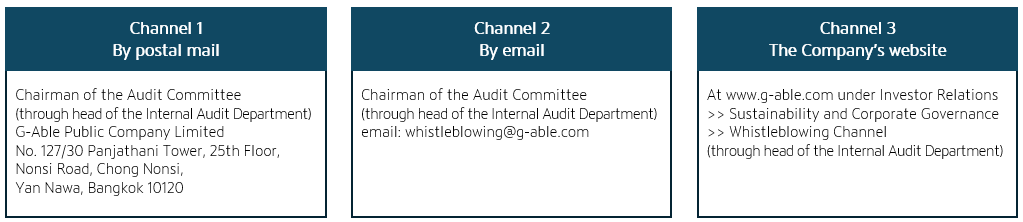
| Whistleblowing and Protection of Whistleblowers | The Company established a Whistleblowing and Complaint Policy to support and provide a channel for directors, executives, employees, and all stakeholders to report clues or complaints with good faith in cases of suspicion or if they witness actions by the directors, executives, and employees of the Company’s group or by any individuals acting on behalf of the Company’s group that may have a negative impact to the Company’s group, such as unlawful acts, violations of human rights, violations of the Company’s policies, rules and regulations, fraudulent activities, actions that involve conflicts of interest, and absence of protection or adverse impacts resulting from whistleblowing, filing complaints, providing information, cooperating in fact-finding and investigations, or refusing to engage in fraudulent activities. This remains applicable regardless of whether the whistleblower or complainant has personally suffered damage from the actions in question. The Company does not accept anonymous whistleblowing or complaints that lack the identity of the whistleblower or complainant, fail to identify witnesses, or do not provide clue with sufficient evidence to enable further fact-finding.
Filing Channels
In this regard, the filing channels are secure, allowing whistleblowers or complainants access with confidence when submitting information or filing complaints, free from any risk to the whistleblowers or complainants in the future. The Company, through the complaint coordinator, will oversee the investigation process to ensure it is conducted following determined procedures. All investigations and conclusions of each clue or complaint will be documented in written. The Company will not disclose any information that could identify the identity of whistleblower, complainant, informant, relevant party, and alleged suspect. The Company will keep those information confidential, limiting access to only those responsible for gathering, verifying and investigating the facts related to clue or complaint. Details of the oversight of the compliance with the whistleblowing policy can be found in 8.1.4 Monitoring of compliance with corporate governance policy and guidelines. | https://investor.g-able.com/storage/download/sustainability/cg/policy/20260114-gable-whistle-blowing-policy-en.pdf | |
| Preventing the Misuse of Inside Information | The Company manages its operations by adhering to business practices of honesty, integrity, transparency, and in accordance with good corporate governance principles. To ensure that the Company discloses information to all groups of stakeholders equally, and inside information that may affect the Company are kept and protected to the use, the Company has established a policy for the retention and protection of inside information for the directors, executives, employees, and related parties to use as a guideline for their discharge of duties. The Company sets the guidelines as follows: (a) The Company has established a hierarchy of importance for inside information, where the sensitive information shall be handled in a specific way. The information is categorized by priority, including disclosable information, information prepared for disclosure, and confidential information. The use of inside information shall be within the scope of assigned duties and responsibilities only. (b) The Company shall keep customer and trade-related information confidential and shall not disclose customer information to employees or unrelated third parties, unless required by law to disclose publicly or approved by the Board of Directors and/or the Executive Committee. (c) In the event of employing individuals who have previously worked with competitors or government entities, the Company shall review any confidentiality agreements these individuals have entered with. The Company shall not take any actions that would lead these individuals to breach their agreements with competitors or government entities, that will potentially cause legal action. (d) The disclosure of inside information to the public requires approval from the Chief Executive Officer. The Chief Executive Officer may provide the information to the public personally if the information is significantly material or may delegate the responsibility to another department. In addition, the Company has an investor relations department to coordinate and provide information to the public. (e) The personnel of the Company shall not answer questions or provide comments to third parties unless they are assigned to do so. (f) Directors, executives, officers and employees of the Company and its subsidiaries, including spouses and minor children of such persons, are prohibited from using inside information of the Company and its subsidiaries that may affect the change in the price of the Company’s securities which has not been disclosed to the public, for the purpose of buying, selling, offering to buy, offering to sell, or encouraging others to buy, sell, offer to buy, or offer to sell securities of the Company, whether directly or indirectly, before such information is disclosed to the public. Any such actions, whether taken for personal gain or for the benefit of others, or to induce others to engage in such actions for personal gain, will result in disciplinary measures by the Company and its subsidiaries. (g) Directors, executives and employees of the Company and its subsidiaries who know the Company’s inside information are prohibited from disclosing such information to third parties or any persons not related to their responsibilities. Furthermore, directors and executives of the Company, including their spouses and minor children, are prohibited from buying or selling the Company’s securities during one month prior to the disclosure of the financial statements or any significant information to the public and at least 24 hours after the disclosure of the financial statements or significant information to the public. (h) Directors and executives, including persons who hold the executive positions in accounting or finance with manager level up or equivalent, shall personally do by themselves together with their spouses or minor children including juristic persons (that directors, executives, spouses or minor children of such directors and such executives collectively holding shares more than 30 percent of the total number of voting rights and the combined shareholdings of the largest proportion in such juristic persons) to report to the Board of Directors (through the Company Secretary) about their securities transactions regarding the Company at least one day in advance before securities trading. After the securities transaction has been executed, a report on changes in securities holding shall be prepared, disclosed, and submitted to the SEC in accordance with the regulations set forth in the securities and exchange law and send a copy of this report to the Company Secretary at the same date of submission to the SEC. The report shall be prepared in the form determined and submitted to the SEC within the period required by law. In this regard, the Company will share knowledge to directors and executives, including persons who hold the executive positions in accounting or finance with manager level up or equivalent and the Company’s auditors regarding to the duty to report the holdings and report the changes of holdings in securities and derivatives of themselves, their spouses or minor children including juristic persons (that directors, executives, spouses or minor children of such directors and such executives collectively holding shares more than 30 percent of the total number of voting rights and the combined shareholdings of the largest proportion in such juristic persons) to the SEC as stipulated in the securities and exchange law. Details of the oversight of the compliance with the policy on protection of inside information can be found in 8.1.4 Monitoring of compliance with corporate governance policy and guidelines. | https://investor.g-able.com/storage/download/sustainability/cg/policy/20260114-gable-protection-of-inside-information-policy-en.pdf | |
| Compliance with laws, rules and regulations | The Company places great importance on respecting and complying with laws, rules, and regulations related to business operations. The Company’s personnel shall study, understand, respect, and strictly adhere to the laws, rules, orders, and regulations of the Company, as well as respecting local customs, traditions, and culture. In addition, the Company’s personnel shall report complaints and whistleblowing when witnessing violations or non-compliance with the laws. | https://investor.g-able.com/storage/download/sustainability/cg/policy/20260114-gable-company-code-of-conduct-en.pdf | 6-7 |
| Human rights | The Company places great importance on human rights and is committed to conducting its business with respect for, and in support of, the human rights of stakeholders throughout the business value chain, in alignment with international standards such as the United Nations Universal Declaration of Human Rights (UDHR), the United Nations Guiding Principles on Business and Human Rights (UNGPs), the International Labor Organization’s (ILO) Declaration on Fundamental Principles and Rights at Work, as well as applicable laws and regulations. To this end, the Company established a Human Rights Policy as a standard framework for managing human rights matters. This is to ensure that the Company operates responsibly and transparently, avoids any human rights violations, and, where necessary, provides appropriate remediation and manages potential impacts should any violations occur. The policy terms and guidelines are as follows: (a) The Company recognizes and respects human rights by treating all stakeholders equally and fairly, without discrimination, and is committed to fostering a corporate culture grounded in respect for human rights. (b) The Company complies with all applicable human rights laws, both in Thailand and in other countries where the Company and its business representatives operate on its behalf. (c) The Company exercises the utmost care in overseeing its business operations to prevent the risk of human rights violations. It is firmly committed to not engaging in or tolerating any acts or omissions that would constitute a violation of human rights. This includes, in particular, the protection of labor rights, such as the illegal immigrant employment, child labor, human trafficking, and forced labor. (d) The Company supports and encourages all parties involved in its business operations, both directly and indirectly, to conduct their business activities in compliance with applicable laws and with respect for human rights. (e) The Company manages human rights issues through a comprehensive Human Rights Due Diligence process, in line with the UNGPs, on an ongoing basis. (f) The Company provides safe and secure channels for reporting observed or suspected human rights violations related to the Company, with protective measures for whistleblower and confidentiality maintained in accordance with the Company’s Whistleblowing and Complaint Policy. (g) The Company imposes disciplinary actions against its personnel who commit or are complicit in human rights violations. Appropriate remedial measures are provided to affected parties in cases where human rights violations arise in connection with the Company’s business operations. | https://investor.g-able.com/storage/download/sustainability/cg/policy/20260114-gable-human-rights-policy-en.pdf |
Promoting Compliance with the Code of Conduct
Promotes Compliance by Directors, Executives and Employees
Yes
Description
The Company by company secretary department communicated the Board of Directors’ Code of Conduct, which covers policies on prevention of insider information misuse and conflict of interest, to the Board of Directors.
The Company by legal and compliance department monitored and oversaw compliance with laws and the Company’s policies, including the Code of Conduct and Business Ethics, by the executives and employees of the Company’s group in 2025. The executives and employees were provided with self-assessment questionnaires to communicate and raise awareness of their responsibilities in complying with laws and the Company’s policies. In this process, as of 16 January 2026, 1,405 executives and employees of the Company’s group, representing 97.5 percent of all 1,441 employees, participated in the assessment, and most of those who participated assessed themselves as being in full compliance with laws and the Company’s policies, including the Code of Conduct and Business Ethics.
Anti-Corruption Networks & Projects
Joined or Declared Intent to Join Anti-Corruption Networks
Yes
Networks & Projects Joined
| Network / Project | CAC Certified |
|---|---|
| Thai Private Sector Collective Action Against Corruption: CAC | Y |
| United Nations Global Compact (UNGC) | |
| Participation of anti-Corruption networks and initiatives |
Material Changes & Developments in CG
Reviewed the CG Policy or Board Charter in the Past Year
Yes
Material Changes or Developments in the Past Year
Yes
Policy Review — Description
The Board of Directors regularly reviews the Company’s policies, as well as the charters of the Board of Directors and the sub-committees on an annual basis. In 2025, the key focus of reviewing, amending, and adding the Company’s policies was to ensure alignment with the ESG assessment criteria of the FTSE Russell ESG Scores, which will take effect in 2026. Accordingly, the Human Rights Policy and the Human Resources Management Policy were separately prepared to clearly define relevant standards and practices. With respect to the charters of the Board of Directors and the sub-committees, the Board of Directors reviewed and amended them in accordance with the recommendations provided by each sub-committee to ensure they remain up to date. In addition, to enhance efficiency and effectiveness in corporate governance, the Board of Directors approved the annual budget together with the determination of the Company group’s strategies and directions to achieve its targets, taking into consideration the industry trends and challenges that it may face.
Implements the CG Code for Listed Companies
No
CG Code — Description
The Company prioritizes compliance with good corporate governance principles for listed companies, following the guidelines of the SET and the SEC. In 2025, the Board of Directors reviewed the implementation of the CG Code to better suit the business context of the Company. While most of the principles have been implemented, there are some areas where the Company’s approach differed from those outlined in the CG Code.
The Chairman of the Board of Directors should ideally be an independent director.
Even though the Chairman of the Board of Directors is not an independent director, the Company has set in place an adequate and appropriate internal control system and a check and balance mechanism that is transparent and verifiable. In addition, the Chairman of the Audit Committee, as an independent director, is assigned to jointly consider the agenda items for the Board of Directors’ meeting, ensuring that the Board of Directors can use their discretion independently in decision-making.
The Board of Directors should appoint the Nomination Committee and the Remuneration Committee, with the chairman and majority of members being independent directors.
At present, the Nomination and Remuneration Committee consisted of 1 independent director serving as the chairman and 2 non-executive directors as committee members. This composition is deemed appropriate. Although majority of members are not independent directors, each member exercises independence in carrying out their duties responsibly, as assigned by the Board of Directors. Furthermore, they have the ability to approve or oppose decisions without interference from management or any other parties, which is concretely reflected in the committee’s performance.
Other CG Performance & Outcomes
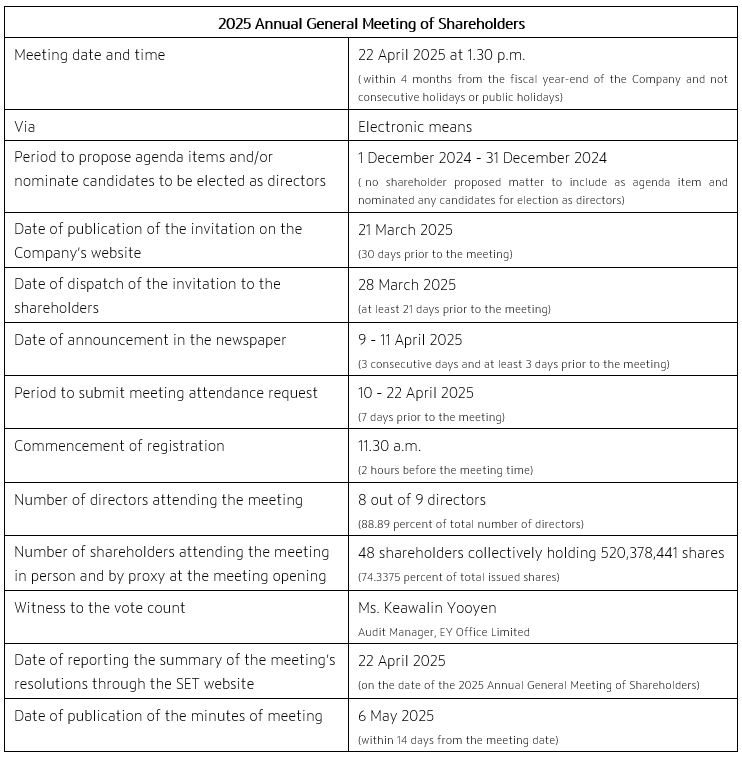
The Company held the 2025 Annual General Meeting of Shareholders via electronic means on 22 April 2025 in compliance with laws, the Company’s policies, and good corporate principles. This included (i) treating all shareholders equally and fairly, (ii) encouraging shareholders to propose agenda items or nominate candidates to serve as directors of the Company in advance of the shareholders’ meeting under clear criteria, methods, and conditions, (iii) providing opportunities for shareholders to submit questions in advance of the shareholders’ meeting, (iv) ensuring that invitation to the shareholders’ meeting specifies the date, time, and meeting venue, along with accurate and adequate information regarding agenda item, objectives, reasons, and the Board of Directors' opinions on each item for the shareholders to exercise their rights, (v) preparing invitation to shareholders’ meeting in both Thai and English and disseminating them through the Company's website at least 30 days prior to the shareholders’ meeting, (vi) delivering invitation to shareholders’ meeting to shareholders no less than 14 days before the shareholders’ meeting to allow shareholders to thoroughly review the information, (vii) conducting shareholders’ meeting in an orderly, transparent, and efficient manner, (viii) enabling shareholders to exercise their rights, (ix) disclosing the resolutions passed at the shareholders’ meeting, along with the voting results, on the SET’s website and the Company's website within the next business day, and (x) submitting a copy of the minutes of the shareholders’ meeting to the SET within 14 days following the meeting date.
As regards the development of the Company’ s business operations in consistent with the good corporate governance, the Company’s achievements in 2025 are highlighted as follows:
(1) a full score of 100 from the 2025 Annual General Meeting Assessment (AGM Checklist) by Thai Investors Association.
(2) an excellent 5-star rating in the Corporate Governance Report of Thai Listed Companies from the Thai Institute of Directors for two consecutive years.
(3) a certified member of the Thai Private Sector Collective Action Against Corruption, demonstrating the Company’s commitment to conducting business in transparent and verifiable manner.