

Board Performance · 2025
In this section15 topics
- Compliance Monitoring — Overview2 items
- Prevention of Conflicts of Interest3 items
- Prevention of the Use of Inside Information3 items
- Anti-Corruption4 items
- Whistleblowing3 items
- Selection of Directors & Chief Executives6 items
- Selection of Independent Directors2 items
- Director Development1 item
- Evaluation of Board & Subcommittee Performance3 items
- Subcommittees1 item
- Meeting Attendance & Remuneration3 items
- Supervision of Subsidiaries & Associated Companies4 items
- Board Duty Performance — Overview1 item
- Audit Committee Duty Performance2 items
- Executive Committee Duty Performance1 item
Compliance Monitoring — Overview
Compliance Monitoring — Introduction
The Company places importance on corporate governance by establishing objectives, vision, missions, policies, and related practices in its corporate governance policy, code of conduct and business ethics, and communicating the same to its employees for adherence. This is to foster confidence among stakeholders. The Company conducts regular reviews to ensure compliance with its corporate governance policies and practices.
Monitoring of Compliance with Other CG Policies & Guidelines
The Company oversees the compliance with its policies and guidelines by continually raising awareness through regular arrangement of compliance refreshment course.
In 2025,
1. All directors were communicated with (a) the anti-corruption matters, including definition, form and cause of corruption, the Company’s policy and regulation regarding anti-corruption, do and don’t, as well as impact and penalty from corruption, and (b) the Board’s Code of Conduct, including prevention of insider information misuse and conflict of interest matters.
2. Over 98 percent of executives and employees of the Company’s group attended the 2025 online compliance refreshment program, from 16 October 2025 to 15 December 2025, as detailed below.
Course | % of participated employees* |
Code of Conduct and Business Ethics | 99.09 |
Personal data protection awareness | 98.20 |
Cybersecurity awareness | 98.27 |
Anti-corruption guidelines | 98.12 |
* There were 1,464 employees in the Company’s group in total. To pass the course, employees were required to score above 80 percent on the end-of-course assessment.
Furthermore, the Company has the Internal Audit Department being responsible for reviewing compliance with laws and policies of the Company and providing recommendations to enhance work processes if they are found to be inadequate or inappropriate. To date, no significant issues have been identified in the audit reviews.
Prevention of Conflicts of Interest
Has the Company Acted to Prevent Conflicts of Interest?
Yes
Operations in the Past Year
The Company established a policy regarding the prevention of conflicts of interest to ensure that all related persons perform their duties based on the principle that all transactions or activities of the Company must be conducted for the maximum benefit of the Company, shareholders, and investors. It is essential to avoid actions that may cause conflicts of interest. This policy regarding the prevention of conflicts of interest was reviewed at the Board of Directors’ Meeting No. 1/2026 on 13 January 2026. Additionally, important guidelines can be found in 6. Corporate Governance Policy.
In 2025, the Company’s directors and executives prepared their annual declaration of conflicts of interest, which was submitted to the Company Secretary for gathering and duly acknowledged by the Chairman of the Board of Directors and the Chairman of the Audit Committee in January 2026. Regarding related party transactions, the Company conducted them appropriately and reasonably. Details can be found in 9.2 Related Party Transactions. Additionally, the Company communicated the policy regarding prevention of conflicts of interest to all executives and employees through its intranet system. Furthermore, details of the policy regarding prevention of conflicts of interest and related party transactions undertaken by the Company and its subsidiaries in 2025 were provided to the directors.
Number of Conflict-of-Interest Cases
| Metric | Current Year | Previous Year | Two Years Ago |
|---|---|---|---|
| Total number of cases or issues related to conflicts of interest (cases) | 0 | 0 | 0 |
Prevention of the Use of Inside Information
Has the Company Acted to Prevent the Use of Inside Information?
Yes
Operations in the Past Year
The Company managed its operations with integrity, honesty, transparency, and in accordance with good corporate governance principles. To ensure equal disclosure of information to all stakeholders and to safeguard against the misuse of inside information that could impact the Company, a policy regarding retention and protection of inside information was established. This policy serves as guidelines for the directors, executives, employees, and related persons to follow in their performance. Without proper measures for effective oversight or if the information is misused, it could lead to unfair or improper actions that may adversely affect the Company. The policy regarding retention and protection of inside information was reviewed at the Board of Directors’ Meeting No. 1/2026 on 13 January 2026. Additionally, important guidelines can be found in 6. Corporate Governance Policy.
In 2025, the Company communicated the policy regarding retention and prevention of inside information to all directors, executives and employees. The Company Secretary Department also informed of the blackout period for trading securities to the directors, executives, and employees via email. In this regard, there were no allegations against any directors, executives, or employees regarding the misuse of inside information for trading securities for personal or others' benefits. In addition, no director or executive has been fined, accused, or subjected to civil proceedings by regulatory authorities for unfair practices or exploiting investors through the use of inside information.
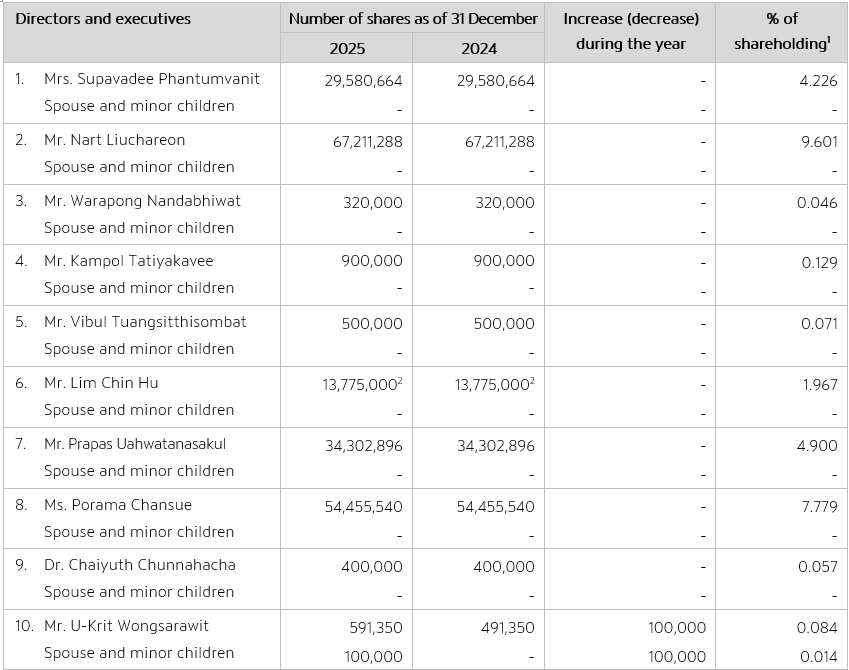
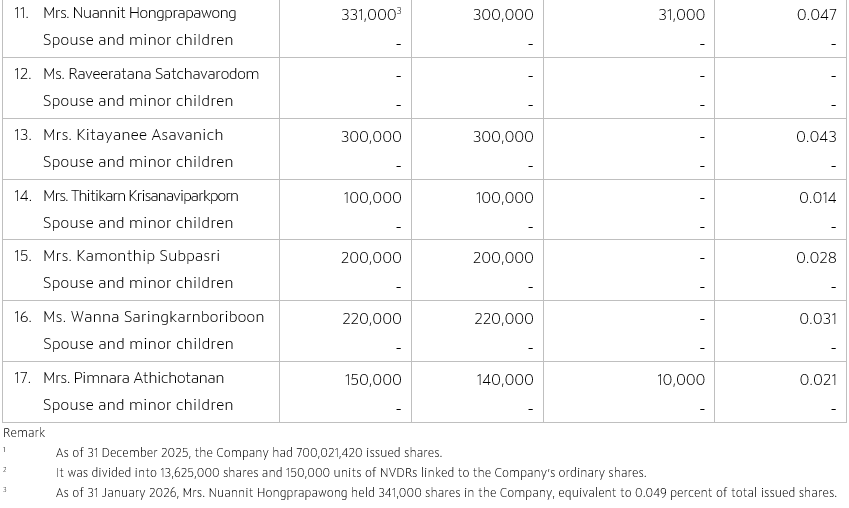
Summary of changes in securities holding of the directors and executives in comparison of 2025 and 2024
(It has been reported to the Board of Directors’ Meeting No. 2/2026 on 24 February 2026 for acknowledgement.)
Number of Inside-Information Cases
| Metric | Current Year | Previous Year | Two Years Ago |
|---|---|---|---|
| Total number of cases or issues related to the use of inside information to seek benefits (cases) | 0 | 0 | 0 |
Anti-Corruption
Has the Company Acted on Anti-Corruption?
Yes
Operations in the Past Year
The Company established an anti-corruption policy as a guideline for conducting business ethically, emphasizing responsibilities to society and stakeholders' interests under a framework of good corporate governance principles. It promotes ethical conduct, transparency, and implements internal controls and audits to minimize the corruption possibility within the organization, demonstrating a firm stance against all forms of corruption. This anti-corruption policy was reviewed at the Board of Directors’ meeting No. 1/2026 on 13 January 2026. The following are key provisions in the anti-corruption policy.
1) The Company’s personnel (including directors, executives and employees) are prohibited from demanding, engaging in, or accepting fraud and corruption for the benefit of the Company, themselves, their families, friends, acquaintances, and related persons.
2) The Company’s personnel (including directors, executives and employees) shall adhere to the anti-corruption policy, refraining from involvement in any form of fraud and corruption, whether directly or indirectly.
3) The Company’s personnel (including directors, executives and employees) shall not overlook or ignore any observed or suspected acts of fraud and corruption. They are required to report such incidents to the Company through the designated reporting channels and cooperate in investigating the facts.
4) The Company implements a risk management system for fraud and corruption. This involves risk assessments, risk prioritization, and establishment of measures, regulations, and procedures to prevent fraud and corruption incidents. Additionally, the Company puts in place adequate audit and compliance controls and consistently monitors the progress of implemented measures to maintain risks at an acceptable level. Fraud and corruption risk is classified as one of the Company’s operational risks at the functional level, with regular reporting to the management.
Additionally, important guidelines can be found in 6. Corporate Governance Policy.
In early 2025, the Company established anti-corruption procedures, which clearly outline the Company's end-to-end procedures for preventing fraud and corruption. These guidelines serve as a strict framework for directors, executives, and employees to follow in their operations. Furthermore, the Company has declared its intention to joining the Thai Private Sector Collective Action Against Corruption (CAC) and later became the CAC certified member with an effect from 31 December 2025.
The Company communicated and provided training to the directors, members of sub-committees, executives, and employees to educate them about the anti-corruption policy. It also established channels for submitting complaints regarding corrupt acts, along with protective measures to safeguard the confidentiality of whistleblowers or complainants. If the Company discovers instances of bribery, corruption, or violations of its policies, it will consider them as breaches of work regulations. The wrongdoer shall be subject to disciplinary action, and potentially legal consequences if the actions are unlawful. It is noted that in 2025, the Company did not receive any reports or complaints regarding bribery, fraud, or corruption through designated channels according to requirements set forth in the Whistleblowing or Complaints Policy.
Form of Anti-Corruption Operations
| Operation |
|---|
| Review of appropriateness in anti-corruption |
| The participation in anti-corruption projects |
| Assessment and identification of corruption risk |
| Communication and training for employees on anti-corruption policy and guidelines |
| The monitoring of the evaluation of compliance with the anti- corruption policy |
| Review of the completeness and adequacy of the process by the Audit Committee or auditor |
Number of Corruption Cases
| Metric | Current Year | Previous Year | Two Years Ago |
|---|---|---|---|
| Total number of cases or issues related to corruption (cases) | 0 | 0 | 0 |
Whistleblowing
Has the Company Implemented Whistleblowing Procedures?
Yes
Operations in the Past Year
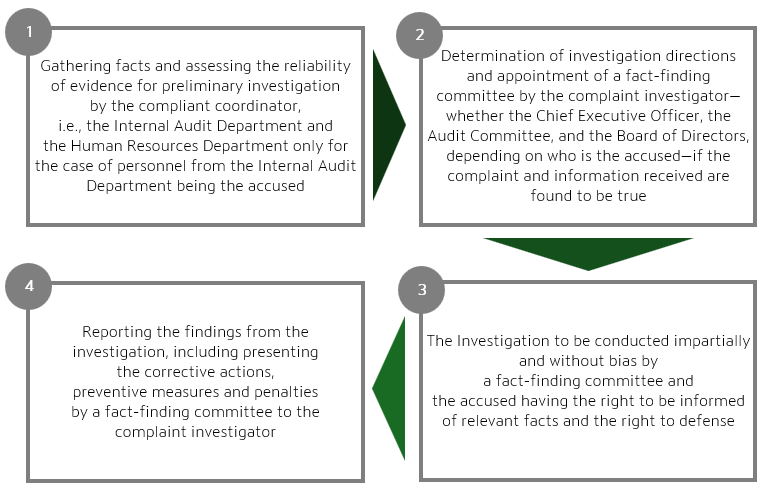
The Company established a policy for whistleblowing or complaints regarding wrongdoing, including but not limited to unlawful acts, violations of human rights, violations of the Company’s policies, regulations and rules, fraudulent activities, and undertaking actions that involve conflicts of interest, to serve as a channel for directors, executives, employees, and stakeholders of the Company to report complaints with integrity. The policy for whistleblowing or complaints was reviewed at the Board of Directors’ Meeting No. 1/2026 on 13 January 2026. The Company has established independent and reliable channels and designated personnel to receive whistleblowing reports and complaints with clear procedures for handling reports, implementing protection measures to safeguard whistleblowers, complainants, and related individuals from retaliation, harm, or unfair treatment, as well as proper reporting mechanisms, where the head of internal audit is responsible for reporting the number of clues or complaints, summary of incidents, and the status of ongoing actions (if any) to the Audit Committee, which consists entirely of the Company’s 3 independent directors, on a quarterly basis. Details of the Company’s designated filing channels can be found in 6. Corporate Governance Policy.
It is noted that in 2025, the Company did not receive any clues or complaints from internal or external stakeholders through designated channels according to requirements set forth in the Whistleblowing or Complaints Policy. Additionally, no violations of the Company's policies, regulations, or rules, including breaches of the Code of Conduct and Business Ethics, were identified. Furthermore, the Company did not incur any fines or penalties related to non-compliance with applicable laws or regulations. Nevertheless, the Company shall review and handle any clues and complaints received through channels outside the designated ones, or those do not fall within requirements set forth in the Whistleblowing or Complaints Policy, as deemed appropriate.
Procedures when receiving clues or complaints
Number of Whistleblowing Cases
| Metric | Current Year | Previous Year | Two Years Ago |
|---|---|---|---|
| Total number of cases or issues received through whistleblowing channels (cases) | 0 | 0 | 0 |
Selection of Directors & Chief Executives
Directors & Chief Executives — Introduction
Nomination of directors
The selection of individuals to be appointed as directors is assigned to the Nomination and Remuneration Committee by the Board of Directors. The Nomination and Remuneration Committee is responsible for selecting individuals who possess the qualifications required by securities and exchange laws, as well as other relevant laws, and who meet the criteria set forth by the Company, and then presents its recommendations to the Board of Directors and/or the shareholders’ meeting for consideration and appointment, as stipulated in the Company's articles of association.
The criteria and methods for the nomination of director, as well as the election and/or appointment process, begin with the Nomination and Remuneration Committee reviewing the qualifications and diversity of skills, knowledge, expertise, and experience of directors, as well as overall composition through skill matrix, ensuring alignment with the Company's business strategy and direction. This skill matrix is conducted without limitations based on gender, race, religion, age, and specific abilities, and includes devoting time to fully perform duties. In the appointment of a new director, the Nomination and Remuneration Committee considers the skill and expertise of each director through skills matrix to define the required qualifications, taking into account the necessary skills that may be lacking in the current Board of Directors, aiming to achieve diversity within the structure. Additionally, the Nomination and Remuneration Committee may consider candidates from (i) recommendations given by the executives, directors, and external individuals with credibility, (ii) the director pool database or (iii) data from a professional search firm. Moreover, the Nomination and Remuneration Committee welcomes suggestions from minority shareholders proposing individuals for considering and appointing as director during the general meetings of shareholders, following the Company’s defined criteria. At the shareholders’ meeting, the election of directors will be conducted by using the majority votes of the shareholders attending and voting, following the criteria and methods specified in the Company's articles of association as follows:
1. Each shareholder is entitled to one vote for each share they hold.
2. Each shareholder may use the total number of votes to elect one or several candidates as directors. If several candidates are to be elected as directors, the votes may not be split among candidates.
3. In descending order, the candidates with the most votes will be elected as directors. Directors must be elected in the number of available seats at that meeting. The chairman has one casting vote if the candidates in the next lower ranking of votes have an equal number of votes and the number of available seats at the meeting is exceeded.
Nomination of senior executives
The Board of Directors shall ensure that the selection and development of the Chief Executive Officer and the C-level executives are equipped with the knowledge, skills, experience, and qualifications essential to drive the organization toward its goals. This includes encouraging them to attend training courses and/or to participate in activities that enhance their knowledge and experience, benefiting their roles. In this regard, the Board of Directors has assigned the Nomination and Remuneration Committee to be responsible for considering criteria and methods for selecting individuals with suitable qualifications for the position of Chief Executive Officer, which is the top management position within the organization. For senior executive positions, the Board of Directors shall monitor the Chief Executive Officer to ensure that the Company has appropriate senior management. At least, the Board of Directors or the Nomination and Remuneration Committee (if any) together with the Chief Executive Officer shall consider the criteria and methods for selecting and appointing individuals nominated by the Chief Executive Officer to be senior executives.
In addition, the Company establishes a succession plan, to ensure that business continuity for the Chief Executive Officer and key executives is in place. The Board of Directors or assigned sub-committee (at present, the Nomination and Remuneration Committee) shall determine and review the succession plan for top management position, namely Chief Executive Officer, whereby the Chief Executive Officer shall determine the succession plan for key executives by recruiting in-house personnel with high potential who are suitable for qualifications, able to perform excellence above organization expectations, having suitable attitudes and behaviors to the corporate culture, as well as being appropriate in terms of maturity to hold a key executive position. This is to ensure that the work in the responsibilities of the position is continuous and can lead the Company to sustainable growth.
Furthermore, the Company established a policy regarding the holding of directorship positions in other listed companies by the Chief Executive Officer and senior executives. This policy clearly states that each of them is allowed to hold a directorship position in other listed companies, up to a maximum of 3 companies, subject to approval from the Board of Directors.
Appointment and Removal of Directors
1. At every annual general meeting of shareholders, one-third of directors shall retire from the office. If the total number of directors is not divisible by one-third, then the directors closest to one-third shall retire from office. The directors who shall retire from the office in the first and second year after the incorporation shall be determined by drawing lots. In subsequent years, the directors who have served the longest term shall retire. A retiring director is eligible for re-election.
2. Apart from retirement by rotation, the director shall vacate office upon death, resignation, lack of qualifications, or possession of a prohibition under the laws, removal by a resolution of the shareholders’ meeting, or removal by a court order.
3. In case a director position becomes vacant for reasons other than a retirement by rotation, the Board of Directors may elect and appoint a person who possesses qualifications pursuant to laws as a replacement director at the next Board of Directors’ meeting, unless the remaining term of the former director is less than 2 months. The replacement director shall hold office only for the remaining term of the director whom he/she replaces.
4. Any director who wishes to resign from his/her position shall submit a written resignation letter to the Company. The resignation shall take effect from the date the resignation letter is received by the Company. A director who resigns hereof may notify his/her resignation to the share registrar.
5. The consecutive term of office of the independent directors shall not exceed 9 years from the date of the first appointment as an independent director.
Are Directors Selected Through the Nomination Committee?
Yes
Are Chief Executives Selected Through the Nomination Committee?
Yes
Number of Directors from Major Shareholders
4
Rights of Minority Shareholders on Director Appointment
The Company allows its shareholders to propose candidates for considering and appointing as director during the general meetings of shareholders, following the Company’s defined criteria. For the 2025 Annual General Meeting of Shareholders, the Company allowed the shareholders to nominate candidates for election as directors during 1 October 2024 to 31 December 2024. However, it was found that no shareholder proposed any candidate for election as a director.
Method of Director Appointment
| Method |
|---|
| Method whereby each director requires approval votes more than half of the votes of attending shareholders with voting rights |
Selection of Independent Directors
Criteria for Selecting Independent Directors
The Board of Directors jointly assesses the qualifications of individuals to serve as independent directors. Independent directors must possess qualifications as required by public companies limited law, securities and exchange law, the Notification of the Capital Market Supervisory Board and the notifications of the Securities and Exchange Commission, as well as other relevant laws, regulations, and announcements. Additionally, the Board of Directors assigns the Nomination and Remuneration Committee to propose candidates with suitable qualifications, experience, and other relevant attributes for consideration and appointment as directors at the Board of Directors’ meetings and/or shareholders’ meetings, as the case may be.
The Company's policy requires the appointment of independent directors at least one-third of the total number of directors but not less than three directors. As of 31 December 2025, the Board of Directors comprised 3 independent directors out of 9 directors, which met the requirement of at least one-third of the total number of directors. The qualifications of independent directors of the Company can be summarized as follows:
1. Holding no more than 0.75 percent of the total shares entitling to votes of the Company, its parent company, subsidiary, associated company, major shareholder, or controlling person, including the shares held by related persons of any such independent director.
2. Neither being nor having been a director involving in the management, employee, staff, salaried consultant, or controlling person of the Company, its parent company, subsidiary, associated company, same-level subsidiary, major shareholder, or controlling person, unless foregoing status has ended for not less than two years. In this regard, these prohibited characteristics shall exclude the case where an independent director used to be a government officer or advisor of a governmental agency, which is a major shareholder or controlling person of the Company.
3. Not being a person related by blood or registration under the laws as father, mother, spouse, sibling and child (including the spouse of child) of the director, executive, major shareholder, controlling person, or person to be nominated as director, executive or controlling person of the Company or its subsidiary.
4. Neither having nor having had business relationship with the Company, its parent company, subsidiary, associated company, major shareholder, or controlling person, in a manner which may interfere with his/her independent judgment; neither being nor having been a significant shareholder or controlling person of any person having business relationship with the Company, its parent company, subsidiary, associated company, major shareholder or controlling person, unless the foregoing relationship has ended for not less than two years.
5. Neither being nor having been an auditor of the Company, its parent company, subsidiary, associated company, major shareholder, or controlling person, and not being a significant shareholder, controlling person, or partner of an audit firm which employs auditors of the Company, its parent company, subsidiary, associated company, major shareholder or controlling person, unless the foregoing relationship has ended for not less than two years.
6. Neither being nor having been any professional advisor, including legal advisor, or financial advisor, who receives service fees exceeding THB 2 million per annum from the Company, its parent company, subsidiary, associated company, major shareholder or controlling person; and not being a significant shareholder, controlling person, or partner of such professional advisor, unless the foregoing relationship has ended for not less than two years.
7. Not being a director who is appointed as a representative of the Company’s director, major shareholder, or any shareholder who is related to the Company’s major shareholder.
8. Neither operating a business which has the same nature of business and competes with the business of the Company or its subsidiary nor being significant partner in partnership or director involving in the management, employee, staff, salaried consultant, or holding shares exceeding 1 percent of the total shares entitling to votes of the other companies operating the business with the same nature and in competition with the Company or its subsidiary.
9. Not possessing any characteristic which disables the expression of independent opinions with respect to the Company’s business operations.
Furthermore, for the members of the Audit Committee, in addition to having complete qualifications as independent directors, they must also possess the following additional qualifications:
1. Not being a director appointed by the Board of Directors to make administrative decisions on the operations of the Company, its parent company, subsidiary, associated company, same-level subsidiary, major shareholder, or controlling person.
2. Not being a director of the parent company, subsidiary, or same-level subsidiary of listed companies only.
3. Having sufficient knowledge and experience to perform the duty as a member of the Audit Committee. There must be at least a member of the Audit Committee, who is sufficiently knowledgeable and experienced to review the reliability of financial statements.
4. Being able to allocate sufficient time to fulfill the duties of the Audit Committee.
Did Any Independent Director Have a Business or Professional Relationship?
No
Director Development
Development of Directors in the Past Year
In 2025, the Company undertook the following initiatives: (a) reviewed knowledge on the overall framework and processes of the Company’s risk management, including holding knowledge-sharing sessions on ESG risk, with the Board of Directors and senior executives to raise awareness of risk management as an integral part of the corporate culture; and (b) provided anti-corruption training to the Board of Directors, covering the Company’s policies and procedures, key considerations and precautions, as well as the impacts and penalties associated with corruption, in order to ensure a thorough and genuine understanding.
Evaluation of Board & Subcommittee Performance
Criteria for Evaluating Board Performance
The Company conducts performance assessment evaluations of the Board of Directors and sub-committees at least once a year, both on a group and individual basis. This ensures collective review of performance outcomes and issues for continuous improvement. Assessment criteria cover aspects such as structure and qualifications, meeting, roles and responsibilities, and performance reporting.
Evaluation of Board Performance in the Past Year
Assessment processes of the Board of Directors and sub-committees (both on a group and individual basis) started from the Company Secretary and/or the secretary to each sub-committee delivering performance assessment form to the directors and/or members of sub-committees for completion with the certain return date of completed form. After that, the Company Secretary and/or the secretary to each sub-committee gathered scores and recommendations and presented the same in the respective Board of Directors’ and/or subcommittee’s meeting. In this respect, performance assessment results in 2025 were reported to the Board of Directors’ Meeting No. 2/2026 on 24 February 2026.
Evaluation Results
| Evaluated Body | Group — Carried Out? | Group — Grade / Average Score | Group — Grade / Full Score | Individual (Self-Assessment) — Carried Out? | Individual (Self-Assessment) — Grade / Average Score | Individual (Self-Assessment) — Grade / Full Score | Cross (Assessing Other Directors) — Carried Out? |
|---|---|---|---|---|---|---|---|
| Board Of Director | Y | 98.27 | 100.00 | Y | 99.46 | 100.00 | N |
| Audit Committee | Y | 100.00 | 100.00 | Y | 100.00 | 100.00 | N |
| Other Subcommittee | Y | 96.47 | 100.00 | Y | 100.00 | 100.00 | N |
| Other Subcommittee | Y | 97.73 | 100.00 | Y | 95.00 | 100.00 | N |
| Executive Committee | Y | 93.91 | 100.00 | Y | 91.27 | 100.00 | N |
Subcommittees
Subcommittees
| Results of the Subcommittee's Duty Performance |
|---|
The Nomination and Remuneration Committee of G-Able Public Company Limited (the “Company”) comprises the Chairman and members, totaling 3 persons, who were appointed by the Board of Directors in accordance with the Charter. Each member of the Nomination and Remuneration Committee possesses valuable knowledge, capabilities, and experience beneficial to perform their duties. The Nomination and Remuneration Committee was formed to assist the Board of Directors in formulating the policies, guidelines and practices related to the nomination and remuneration for directors, sub-committee members, senior executives and/or other key executives to the Company (if any), as well as undertaking any other tasks as may be assigned by the Board of Directors. In 2025, the Nomination and Remuneration Committee held a total of 6 meetings to perform any matters in accordance with authorities, duties and responsibilities assigned by the Board of Directors. Details of which are as follows: 1) Considered remuneration criteria suitable for the duties and responsibilities of the directors and sub-committee members, by linking remuneration to performance evaluations, business plans and the Company’s overall performance, and comparing with other listing companies in the same industry with similar market capitalization, to attract and retain knowledgeable, capable, and potential directors, and presented the same to the Board of Directors for endorsement before proposing them to the annual general meeting of shareholders for consideration and approval. 2) Considered and elected the directors in replacement of those who retired by rotation and presented the same to the Board of Directors for endorsement before proposing them to the annual general meeting of shareholders for consideration and approval, provided that the diversity of the Board of Directors through the skill matrix was taken into consideration. 3) Evaluated the performance of the Chief Executive Officer for the year 2024, including setting performance evaluation criteria for the Chief Executive Officer for the year 2025, along with endorsing annual salary adjustment and other forms of compensation for the Chief Executive Officer, and presented the same to the Board of Directors for approval. 4) Considered and approved the performance targets for evaluating the performance of C-level executives, including the Chief Operating Officer, Chief Go to Market Officer, and Chief Finance and Strategy Officer. 5) Considered and established guidelines for succession plan for the Chief Executive Officer, C-level executives, and top management of each subsidiary, along with reviewing a list of suitable candidates for succession and successor development plan. This report had been reviewed by the Nomination and Remuneration Committee on 24 February 2026. For and on behalf of the Nomination and Remuneration Committee Mr. Vibul Tuangsitthisombat Chairman of the Nomination and Remuneration Committee |
The Risk and Sustainability Development Committee of G-Able Public Company Limited (the “Company”) consists of the Chairman (an independent director) and members (a non-executive director, an executive director and an executive) of the Risk and Sustainability Development Committee, totaling 4 persons. They are appointed by the Board of Directors and are responsible for monitoring and providing recommendations on performances regarding risk management and sustainability development across 3 dimensions, namely governance, environmental, and social, in accordance with the Charter of the Risk and Sustainability Development Committee. In 2025, the Risk and Sustainability Development Committee held a total of 4 meetings to perform any matters in accordance with authorities, duties and responsibilities assigned by the Board of Directors. Details of which are as follows: 1) Reviewed the Risk Management Policy, risk management structure, and level of risk appetite (including corporate risk appetite statement and qualitative risk metrics) to ensure suitability and alignment with the business strategies, directions, goals, and objectives of the Company’s group. 2) Acknowledged and provided recommendations on the assessment and management of the key risks within the Company’s group, including monitoring the progress of the risk treatment plans, and reporting the outcomes to the Board of Directors, on a quarterly basis to ensure that the business operations of the Company’s group remained within an acceptable level (risk appetite). 3) Promoted an awareness of risk management by integrating it into the corporate culture. In 2025, the Company arranged seminars to educate its employees about risk, including an overview and the importance of risk management, risk management processes, tools, and reporting, as well as the fraud and corruption risks, and workshops for representatives from various departments to assess their functional risks. 4) Acknowledged and provided recommendations on the Company’s participation in the Thai Private Sector Collective Action Against Corruption (CAC), including the preparation of a corruption risk register, which was a key supporting document in application to become a CAC certified member. On 26 December 2025, it was announced that the Company had passed the CAC evaluation and had become a CAC certified member. 5) Reviewed policies related to corporate governance and sustainability development. In 2025, the key focus of reviewing, amending, and adding such policies was to ensure alignment with the ESG assessment criteria of the FTSE Russell ESG Scores, which would take effect from 2026, replacing the ESG assessment criteria of the SET ESG Ratings. 6) Reviewed and approved the sustainability development targets and provided recommendations on concreate sustainability development plans, including encouraging the Company to participate in various assessments related to corporate governance and sustainability development. In 2025, the Company achieved an excellent 5-star rating in the Corporate Governance Report of Thai Listed Companies from the Thai Institute of Directors for two consecutive years. Additionally, the Company was assessed under the 2025 SET ESG Ratings and received an “A” rating from the Stock Exchange of Thailand, an improvement from the “BBB” rating received in the 2024 SET ESG Ratings. 7) Conducted an annual review of the Charter of the Risk and Sustainability Development Committee in the Risk and Sustainability Development Committee’s meeting on 6 November 2025. 8) Conducted a performance self-assessment for the year 2025. This report had been reviewed by the Risk and Sustainability Development Committee on 19 February 2026. For and on behalf of the Risk and Sustainability Development Committee Mr. Kampol Tatiyakavee Chairman of the Risk and Sustainability Development Committee |
Meeting Attendance & Remuneration
Meeting Attendance — Sub-section Introduction
The Company schedules the Board of Directors’ and sub-committees’ meetings, including agenda items, in advance to allow directors and/or members of sub-committees to allocate time to attend. The frequency of meetings shall be appropriate to the duties and responsibilities, which the Board of Directors’ meeting shall hold at least 6 meetings per year and additional meetings may be convened as necessary. In each meeting, the invitation to the meeting specifying date, time, venue, and meeting agenda, as well as meeting supporting documents shall be delivered to the directors and/or members of sub-committees in advance so that the directors and/or members of sub-committees have time to study them before attending the meetings. In the case of the Board of Directors’ meeting, the invitation to the meeting and meeting supporting documents shall be delivered to the directors at least 5 business days prior to the meeting date. Moreover, the Company supports each director, including management, to independently propose matters beneficial to the Company for inclusion in the meeting agenda.
Furthermore, the Company has a policy allowing non-executive directors to have meetings as needed to discuss various management issues or other matters of interest without management involvement. The outcomes of these meetings shall be reported to the Chief Executive Officer. Accordingly, there was 1 non-executive directors’ meeting held in 2025.
Types of Remuneration of the Board of Directors
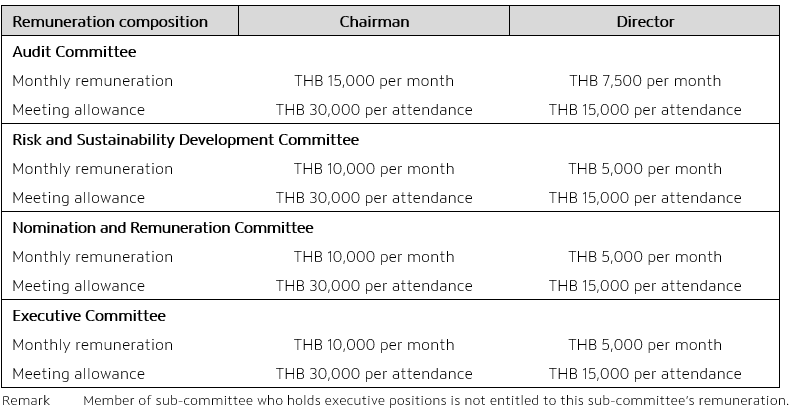
The 2025 Annual General Meeting of Shareholders on 22 April 2025 considered the Board of Directors’ opinion together with the recommendation by the Nomination and Remuneration Committee based on the appropriateness of the scope, duties, responsibilities, the Company's performance, as well as directors’ remuneration of other companies listed on the Stock Exchange of Thailand within the same industry and/or comparable market capitalization. Then the approval of the determination of the director's remuneration for the year 2025 of not exceeding THB 10 million with the following details was granted.
(1) Board of Directors’ remuneration

(2) Sub-committee’s remuneration
(3) Other remuneration - None -
None of the Company’s directors and executives received any remuneration, whether monetary or non-monetary, from being the director of the subsidiaries.
Remuneration or Benefits Payable to the Board
| Metric | Amount (Baht) |
|---|---|
| Remunerations or benefits pending payment to the board of directors over the past year (baht) | 0 |
Supervision of Subsidiaries & Associated Companies
Does the Company Have Subsidiaries or Associated Companies?
Yes
Is There a Mechanism for Overseeing Subsidiaries and Associated Companies?
Yes
Mechanism for Overseeing Management of Subsidiaries
The Company has established a policy on oversight of operations in subsidiaries and associated companies with the objective of setting operational standards. This ensures that the Company can effectively supervise the management of its subsidiaries and associated companies, ensuring compliance with policies of the Company, including legal requirements, regulations, announcements, and governmental orders to maintain the proceeds in investments in subsidiaries and/or associated companies. The details of the policy are as follows:
(a) The Company shall appoint representatives to serve as directors in subsidiaries and/ or associated companies in proportion to the shareholding in each company. This is to oversee that the subsidiaries and/or associated companies operate correctly in accordance with the Company's policies. In this respect, the appointment of representatives shall be considered and approved by the Executive Committee’s meeting, taking into account the suitability of each company.
(b) The Company shall regularly receive reports, strategic plans, business plans, investment plans, budgets, and operating results from its subsidiaries and/or associated companies.
(c) The Company has a policy to ensure that its subsidiaries and/or associated companies have appropriate, efficient, and sufficient internal control system to prevent fraud that may occur. In addition, subsidiaries and/or associated companies shall establish mechanisms for internal system audit, providing internal audit team with access to information and reporting audit results to the Company’s directors and executives to ensure that subsidiaries and/or associated companies adhere to internal control systems effectively.
(d) Directors and/or executives of subsidiaries and/or associated companies shall not participate in approving matters in which they have a direct or indirect interest or conflicts of interest. Such conflicts of interest can result from the approval of transactions in which directors, executives, or related parties of subsidiaries and/or associated companies receive other benefits or cause damage to these entities. Such transactions would be considered a conflict-of-interest transaction.
In 2025, the Company monitored the compliance with this policy by:
- Appointing representatives as directors in subsidiaries and/or associated companies in proportion to shareholding. For example, the Company appointed 4 representatives as directors in R2, exceeding the majority of R2’s total directors. R2 was a company in which the Company held 75 percent of the total shares.
- Ensuring the subsidiaries provide business performance, enabling the Company to prepare complete, accurate, and timely financial reports. In this regard, the Company’s representatives, who serve as subsidiaries’ directors, acknowledged the subsidiaries’ operating results on a quarterly basis and approved key matters of the subsidiaries, such as business plans, strategic plans, and budgets.
- Developing an annual internal audit plan for subsidiaries in Thailand and presenting such internal audit plan to the Audit Committee for approval, as well as conducting audits per approved plan.
Oversight Mechanisms
| Mechanism |
|---|
| Sending representatives to act as directors, executives or controlling persons in proportion to shareholdings |
| Defining the scope of powers, duties and responsibilities of directors and executives who represent the company in setting important policies |
| Disclosure of financial information and operating results |
| Transactions between the Company and related persons |
| Other important transactions |
| Acquisition or disposal of assets |
| Internal control system of the subsidiary operating the core business is appropriate and sufficient in the subsidiary operating the core business |
Board Duty Performance — Overview
Board Duty Performance — Overall Description
G-Able Public Company Limited (the “Company”) recognizes the importance of conducting business under good corporate governance to help promote sustainable growth and maintain credibility. Therefore, the Board of Directors established a good corporate governance policy based on guidelines and practices of the Corporate Governance Code for Listed Companies 2017 by the Securities and Exchange Commission (the "SEC"). In this policy, criteria for diversity of the Board of Directors, including skills, experience, gender, expertise beneficial to the Company, and requirements for selecting executives with leadership, vision, and responsibility, are outlined. The policy also defines management structures with controls and monitoring, power balances, and audits, for clear guidelines and practices to ensure fairness, integrity, and transparency. It emphasizes equal rights for shareholders and stakeholders, sufficient internal control and risk management to enhance the Company's competitiveness, instill confidence among shareholders, investors, and stakeholders, and ensure efficient and stable business operations that create sustainable value for the Company.
Audit Committee Duty Performance
Audit Committee Duty Performance — Introduction
The Audit Committee of G-Able Public Company Limited (the “Company”) consists of the Chairman of the Audit Committee and members of Audit Committee, totaling three persons. They are appointed by the Board of Directors to assist in overseeing the preparation of financial reports, the assessment of the adequacy and effectiveness of the internal control system and risk management system, as well as compliance with applicable laws, regulations, and code of conduct, in accordance with the Audit Committee Charter.
Results of the Audit Committee's Duty Performance in the Past Year
In 2025, the Audit Committee held a total of 7 meetings to perform any matters in accordance with authorities, duties and responsibilities assigned by the Board of Directors. In each meeting, the Audit Committee engaged in discussions with management, auditors, and internal auditors on relevant matters. Additionally, the Audit Committee held one meeting with the auditors without the presence of management. Details of 2025 performance of the Audit Committee can be summarized as follows:
1) Reviewed the Company’s financial reports, including quarterly and annual financial statements that have been reviewed and audited by the auditors. The auditors have been invited to attend every meeting if there was an agenda regarding reviewing the financial statements. The Audit Committee inquired the auditors about the accuracy, completeness, significant accounting adjustments, and adequacy of disclosures to ensure that the Company's financial statements comply with generally accepted accounting standards and serve the interests of stakeholders.
2) Reviewed the adequacy and effectiveness of the internal control system, risk management system, and internal audit function, including consideration of the adequacy of the budget, resources, and independence of the internal audit department. The internal audit department reported directly to the Audit Committee and was tasked with evaluating the appropriateness and effectiveness of the internal control system, covering business operations, prevention and control of loss, financial decision-making authority, and legal compliance. The goal was to ensure that the Company's internal control system is sufficient, with appropriate management tools in place to achieve operational objectives and corporate goals.
3) Reviewed the Company’s compliance with securities and exchange laws, regulations of the Stock Exchange of Thailand, and all applicable laws relating to the Company’s businesses, by meeting with responsible persons, and found that the Company has fully complied with all applicable laws over the past year. Additionally, the Audit Committee reviewed corporate governance practices based on the governance guidelines for listed companies.
4) Considered, selected, and proposed the appointment of the Company’s auditors based on their qualifications, independence, business knowledge, work quality, and reasonable audit fees. The Audit Committee proposed the appointment of auditors from EY Office Limited, i.e., Mr. Vatcharin Pasarapongkul, Certified Public Accountant No. 6660; and/or Ms. Kessirin Pinpuvadol, Certified Public Accountant No. 7325; and/or Mr. Pornanan Kitjanawanchai, Certified Public Accountant No. 7792, to act as the Company’s auditors for the fiscal year 2025. This proposal was submitted to the Board of Directors for endorsement and further presented to the shareholders' meeting for approval of the appointment of auditors and audit fees for the fiscal year 2025.
5) Reviewed connected transactions and transactions that may lead to conflicts of interest and concluded that these transactions were reasonable, beneficial to the Company, and conducted under normal business conditions and agreed commercial terms.
6) Reviewed the internal control system related to fraud and corruption in accordance with the Company's policy, through internal audit conducted by the internal audit department. No significant findings were reported.
7) Reviewed the Charter of Audit Committee and proposed the revision to the Board of Directors for approval.
8) Assessed the performance of the Audit Committee on a group and individual basis for the year 2025.
Overall Audit Committee’s Opinions
In 2025, the Audit Committee carried out its duties and responsibilities under the Audit Committee Charter, which was in line with regulations of the Stock Exchange of Thailand. The Audit Committee maintained sufficient independence, prioritizing the best interests of the Company and safeguarding the interests of all stakeholders. Throughout the performance of duties, the Audit Committee received full cooperation from relevant departments and individuals. The Audit Committee was of the opinion that the Company's financial reports are accurate, reliable, and compliant with generally accepted accounting standards. Additionally, the Company has adequate risk management and effective internal control and audit systems that support the achievement of its objectives and goals. The Company’s operations are in accordance with good corporate governance principles and comply with the public company limited laws, securities and exchange laws, as well as all applicable laws, regulations, and best practices relating to the Company’s business, including the Company's anti-corruption policy.
This report had been reviewed by the Audit Committee on 24 February 2026.
For and on behalf of the Audit Committee
Mr. Warapong Nandabhiwat
Chairman of the Audit Committee
Executive Committee Duty Performance
Results of the Executive Committee's Duty Performance in the Past Year
The Executive Committee of G-Able Public Company Limited (the “Company”) consists of the Chairman and members of the Executive Committee, totaling 7 persons. They are appointed by the Board of Directors and are responsible for overseeing the managerial control of the Company’s operations to ensure the full alignment with the directions, policies, and business strategies outlined by the Board of Directors and to screen the management’s proposals before further presenting them to the Board of Directors for consideration and approval in accordance with the Charter of the Executive Committee.
In 2025, the Executive Committee held a total of 10 meetings to perform any matters in accordance with authorities, duties and responsibilities assigned by the Board of Directors. Details of which are as follows:
1) Performed all undertakings under applicable laws, the Company’s objectives and Articles of Association, as well as resolutions of the Board of Directors’ and shareholders’ meetings, with a duty of loyalty and care, accountability, and ethics, by taking into account the interests of all shareholders in a fair manner.
2) Provided recommendations to the management on the annual budget of the Company’s group before it was submitted to the Board of Directors for approval. In 2025, the Executive Committee reviewed and endorsed the 2026 budget proposal of the Company’s group, where industry trends and challenges that the Company’s group may face had been taken into account, before presenting them to the Board of Directors.
3) Controlled, supervised and monitored the financial performance and position of the Company’s group to ascertain that the business operations fully align with the specified policies, goals, business plans, business strategies and budget in an efficient manner with business well-being and regularly reported the said financial performance and position to the Board of Directors for acknowledgement.
4) Reviewed and approved the anti-corruption procedure, which set out comprehensive end-to-end practices and processes in alignment with the requirements of the Thai Private Sector Collective Action against Corruption (CAC) project, to ensure that employees across the Company’s group can effectively and consistently comply with such procedure in practice.
5) Reviewed and screened all management proposals and endorsed them before presenting them to the Board of Directors. In 2025, various matters had been screened, such as the application for credit facilities from commercial banks, and the provision of joint liability for the credit facilities of subsidiaries.
6) Reviewed and approved transactions that fell under the authority of the Executive Committee as specified in the Delegation of Authority, for instance, the sale of project to the customer including any relevant undertakings, and the increase in customer credit limit.
7) Conducted an annual review of the Charter of the Executive Committee in the Executive Committee’s meeting on 16 December 2025.
8) Conducted a performance self-assessment for the year 2025.
This report had been reviewed by the Executive Committee on 23 February 2026.
For and on behalf of the Executive Committee
Mr. Nart Liuchareon
Chairman of the Executive Committee